Jim Wells County adopts civil-rights policies, names authorized signatories for CDBG‑MIT grant
Loading...
Summary
The county adopted required civil-rights and citizen-participation documents to comply with a Community Development Block Grant-Mitigation (CDBG‑MIT) award and named authorized signatories for administering the grant.
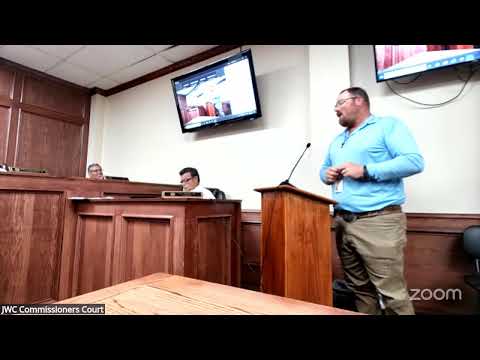
Jim Wells County Commissioners Court on July 14 adopted a package of civil‑rights, citizen‑participation and related policies required under its Community Development Block Grant–Mitigation (CDBG‑MIT) award and designated authorized signatories to execute grant documents. County leaders also proclaimed April as Fair Housing Month to satisfy a grant activity requirement. "Hearing none, can I entertain a motion? Motion to approve," the county judge said after the documents were read aloud and discussion concluded. The court voted by voice; the motion carried.
The adopted package includes a citizens' participation plan and grievance procedure, a Section 3 policy (Housing and Urban Development Act of 1968), a limited English proficiency (LEP) standards plan (Executive Order 13166 referenced), a Section 504 policy (Rehabilitation Act of 1973), an excessive‑force policy for federally assisted programs and a fair‑housing policy. County officials said the policies are required to comply with federal statutes and 24 CFR provisions tied to the CDBG‑MIT award. The resolution naming authorized signatories designates the county judge to execute contractual documents, and the county judge, county auditor and county treasurer to execute state purchase vouchers and requests for payment for the grant (State contract number 24‑065‑170‑F085). The resolution also authorizes the county judge to execute environmental review documents as the responsible entity for the program.
County staff read the written resolution text into the record and asked if there were questions before a motion to approve. The court moved and seconded the motion and adopted the policies and signatory resolution by voice vote.
Why it matters: the measures enable the county to receive and spend CDBG‑MIT funds for eligible mitigation projects while meeting federal nondiscrimination, citizen‑participation and procurement standards and establishing who can sign contract and payment documents on the county’s behalf. The fair‑housing proclamation was described by staff as an activity required by the grant to "affirmatively further" fair‑housing principles.
Discussion versus decision: the transcript shows presentation and reading of the full resolution and associated policies; no substantive debate or amendments were recorded. The court made formal decisions to adopt the listed policies and to designate authorized signatories. The motion passed by voice vote; no recorded dissent or roll‑call tally was provided in the transcript.
Next steps and implementation: staff indicated the adopted policies complete grant requirements and that the county will submit any required forms to the Texas General Land Office and other grant partners. The court did not specify an implementation timeline in the meeting record.