Get Full Government Meeting Transcripts, Videos, & Alerts Forever!
Get email alerts on the School Technology Policy topic
No spam. Unsubscribe anytime.
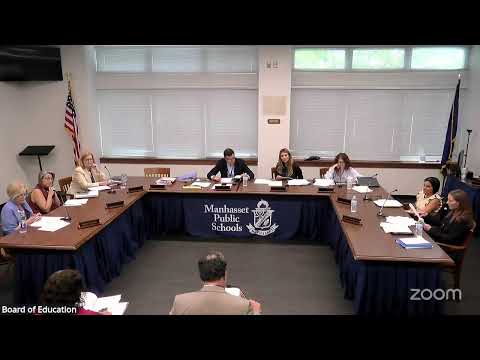
Manhasset Board adopts state-mandated personal electronic device policy, directs building-level rules
Summary
The Manhasset Board of Education approved a new personal electronic device (cell phone) policy required by a state mandate effective Aug. 1, and directed administrators to create building-level regulations and communications for families.
The Manhasset Board of Education voted to approve a first-and-final reading of a district policy implementing a state mandate on personal electronic devices, with the board directing administrators to draft building-level regulations and public communications before the start of the school year. Mariana, a district staff member who presented the policy, told the board, “As of August 1, we are required to have a policy in place.”
The policy matters because the state mandate requires districts to have rules in place by Aug. 1 so families and staff are aware when students return in September. Mariana said the district and shared decision-making committees and building staff reviewed the measure and emphasized that the intent is “to maintain focus on students during this academic school day, to avoid distractions.”
Board members discussed key operational details in public, including where devices will be stored and how enforcement will work. Under the policy, Internet-enabled devices are restricted; non–Internet-enabled devices (for example, older “flip” phones or devices provided by the district for instruction) are excluded from the prohibition. Mariana said secondary students’ phones are expected to be stored in lockers while elementary students will keep phones turned off in cubbies because many elementary classrooms do not have lockers. Mariana also described enforcement options and disciplinary boundaries: “The district may not impose suspension from the school if the sole grounds for the suspension is the student accessing an Internet enabled device as prohibited by this policy. However, the district may utilize consequences under the district code of conduct, including detention, in-school suspension, and exclusion from extracurricular activities for insubordination related to the enforcement of this policy.”
Board members pressed administrators on scenarios that could create practical problems. Rich, a board member, raised operational concerns, saying that “asking four people to enforce the cell phone policy in the building is not reasonable — that’s impossible.” Board members agreed enforcement will be a building-level responsibility and that teachers and administrators should assist, but they asked for clearer language designating the “designated employees” who will assist with enforcement. Members also flagged specific situations that need clarification in building regulations: students who leave campus during free periods (for example juniors and seniors who go off campus for lunch), students who need phones for medical reasons, and how students would be notified in lockdown or emergency situations.
The board approved the policy as presented with a direction to post the policy prominently on the district website, to communicate the change to families before school starts, and to have building leaders draft operational regulations tailored to elementary and secondary settings. Mariana proposed that the commentary and operational details be moved into a building-level regulation document so the board can “learn as we go” and return with adjustments. The board also agreed to reconvene in September or October with Dr. Chalsky and building administrators to review implementation and recommended changes.
Implementation details: secondary students will keep phones in lockers; elementary students will turn phones off and keep them in cubbies; non–Internet-enabled phones and district-issued devices used for instruction are excluded from the restriction; consequences under the code of conduct are allowable but suspension for the sole device violation is not. The board approved the motion without a roll-call tally recorded in the transcript.
Board members repeatedly emphasized the need to communicate the policy widely to families so the start of the year is not a surprise. Mariana and the board indicated the policy language is intended to be flexible initially and subject to revision after building-level regulations are developed and after early implementation feedback.