
North Dakota Supreme Court hears challenge to sufficiency of evidence in Henderson convictions
Get AI-powered insights, summaries, and transcripts
Subscribe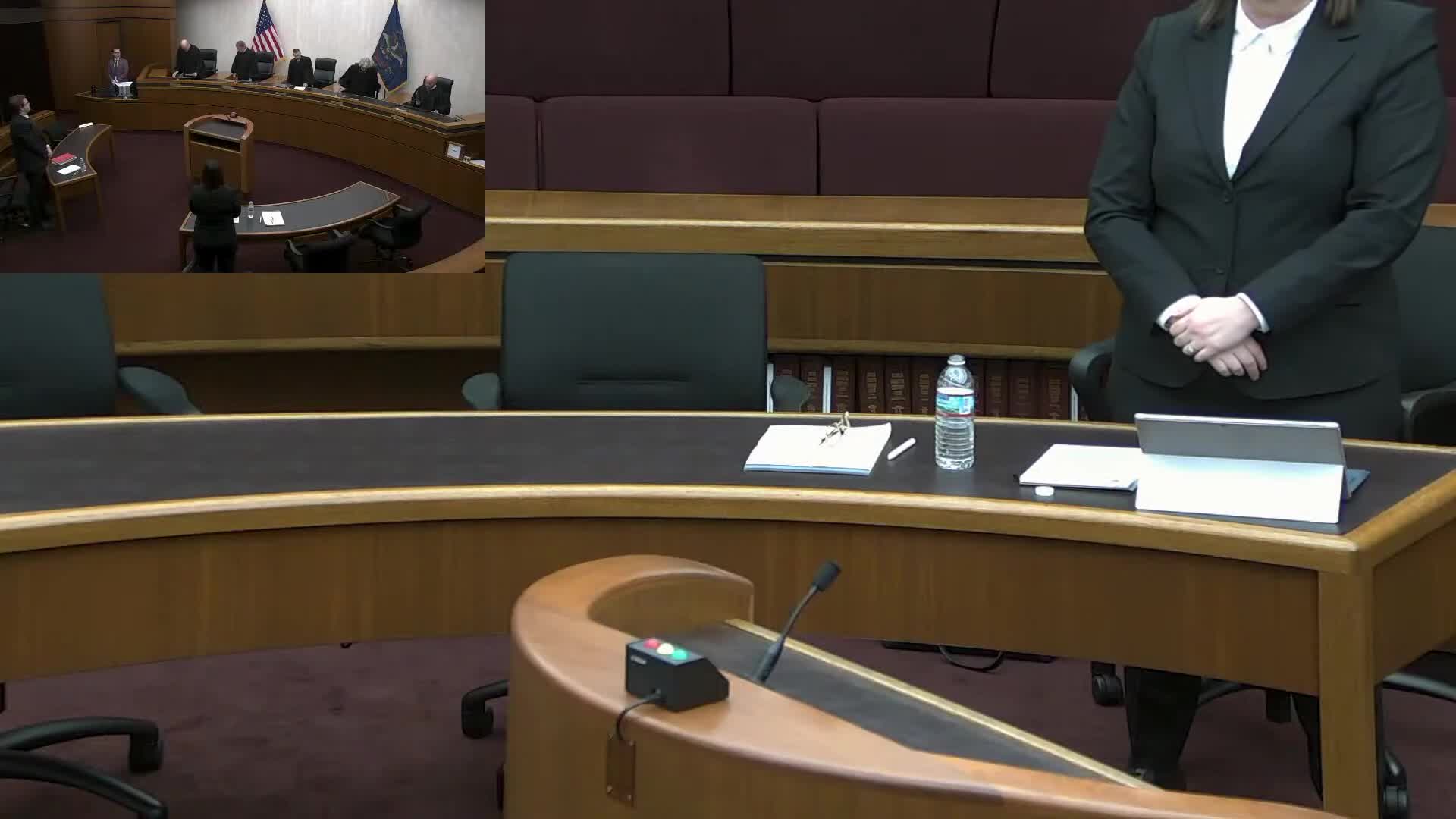
Summary
At oral argument in State v. Jared Henderson, defense and prosecution disputed whether the evidence proved constructive possession of drug paraphernalia and that a seized firearm was operable; the court took the case under advisement.
The North Dakota Supreme Court heard oral argument in State of North Dakota v. Jared Henderson on whether there was sufficient evidence to sustain convictions for unlawful possession of drug paraphernalia and unlawful possession of a firearm.
Appellant counsel Kira Krauspar, representing Jared Henderson, told the court the state failed to prove the elements of constructive possession for the paraphernalia charge and offered insufficient proof that the firearm was operable. Krauspar argued the paraphernalia was found in a kitchen cupboard in a residence where multiple people had access while Henderson was in the garage during the search, and that lab submission paperwork listed four people. "They haven't met their burden. They haven't supplied enough evidence to show he exercised dominion and control over it," Krauspar said.
The defense argued the state did not present evidence tying Henderson temporally or physically to use of the paraphernalia, pointed to testimony the defendant's mail was found nearby but said that did not establish proximity or knowledge, and said that, as to the firearm, the officer took photographs and cleared ammunition but did not test-fire the weapon. "There is no evidence of that," Krauspar said of any proof the firearm was capable of discharging a projectile; she urged the court to reverse the lower-court judgment.
State counsel Logan Simmons replied that the record contains evidence from which a jury could infer constructive possession of the paraphernalia, citing items found in a downstairs bedroom (clothing and hygiene items), testimony that Henderson had not updated his address with probation, jail phone calls in which Henderson referenced the room and specific locations, and mail found near the paraphernalia. On the firearm, Simmons noted the officer testified he cleared the chamber, recovered ammunition and, based on his training and experience, believed the weapon was capable of firing. "The jury could easily make the inference that why would someone keep ammunition if the firearm wasn't capable of firing?" Simmons said, and asked the court to affirm the convictions.
Counsel debated the legal standards and precedents the court should apply, citing this court's case law on constructive possession (including State v. Morris and State v. Dimowski) and the statutory definition of a firearm in North Dakota law (NDCC). The parties addressed whether lay observation and handling by an officer can suffice to prove a weapon is "readily capable" of expelling a projectile, and whether the absence of a test fire or forensic operability test creates an obvious error warranting reversal.
The court did not rule at argument. A court officer stated the case would be taken under advisement and that no decision would be announced from the bench. The justices recessed and the court was adjourned until the next scheduled session.
Background: Henderson appealed convictions on two counts after a search of a family residence. Defense counsel emphasized the house was accessible to multiple people, that evidence submitted to the crime lab listed multiple possible users, and that Henderson was not shown to have been in the area of the paraphernalia when the search occurred. The prosecution emphasized circumstantial evidence the jury heard—including probation records, jail calls, the presence of mail, clothing, and ammunition—and argued the totality of the circumstances supported the convictions.
The court took the case under advisement and will issue a written opinion in due course.