
Mukilteo School Board hears annual language-access report; district outlines interpreter pool, hotlines and cost-saving plans
Get AI-powered insights, summaries, and transcripts
Sign Up Free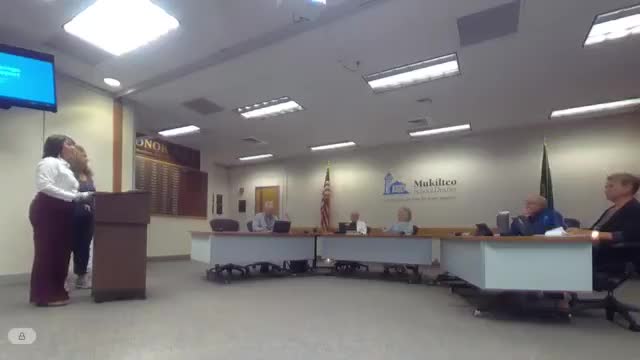
Summary
District staff told the Mukilteo School Board on June 24 that translation devices, language-access kits and a new volunteer/interpreter pool are in place; the district is exploring Ukrainian and Spanish support hotlines and in-house translation to lower costs.
At its June 24, 2025 meeting, Mukilteo School District staff presented an annual report on the district’s language-access work, saying they have deployed translation devices, rolled out language-access kits and created a volunteer clearance process while planning an in-house interpreter pool and Ukrainian and Spanish support hotlines.
District staff members Diane Bradford and Mary Williams told the Mukilteo School Board that the district is now in an “evolve” or maintenance phase of its language-access rollout and is continuing to refine services to meet state requirements. “We are meeting the requirements set out by the state for language access, and we’re still improving,” Bradford said.
The report summarized work completed this school year and next steps. Staff said they deployed electronic translation and interpretation devices across schools and district departments to enable two-way voice and document translation in offices and nurse suites. They also distributed classroom and office “language-access kits” and a welcoming-office checklist for building and department offices.
Staff described expanded training aimed at office staff and family-facing positions such as nurses, family engagement liaisons and counselors, and said the district added ParentSquare for newsletters and messaging with automatic translation into families’ preferred languages. The district also completed an online volunteer application and background-check process and now tracks who is cleared to volunteer or interpret.
Mary Williams said the district secured a noncompetitive grant through the Office of Superintendent of Public Instruction (OSPI) to fund a full-time language-access position that will support translation and secondary attendance work. Bradford and Williams said they are discussing a partnership with the educational nonprofit Boundary 10 to continue supports for refugee and immigrant families.
Staff described two cost-related initiatives they are piloting: an in-house interpreter pool and an internal translation workflow. They gave cost comparisons drawn from current vendor rates — which they said range roughly from $58 to $85 per hour for common interpretation and can exceed $100 per hour for specialty interpretation, often with a two-hour minimum — and a planned district rate target of roughly $27 to $40 per hour depending on specialty. Bradford said the district expects the in-house pool to produce net savings once training and testing requirements are met.
Bradford and Williams gave examples of grant-funded purchases from Boundary 10 this school year. The district reported approximately $130,000 in Boundary 10 support for district-office items including a $16,669 student-health-equity allocation used for vision screening and glasses in some cases; about $25,000 for communication and assistive-technology devices to equip classrooms; $10,206 for tier 1 sensory supports across 13 elementary sites; $15,000 for testing headphones for roughly 20 buildings; and $5,000 to buy about 200 gas cards to help families with transportation until bus routing can be set.
Staff also described family-facing steps: continuing to collect data on interpreter and device use, promoting ParentSquare and other tools, expanding family training about language-access rights and how to request interpreters, and surveying families to better measure needs. Bradford said district staff estimate roughly 116 languages are spoken in students’ homes and acknowledged gaps for less-common or unwritten languages, which will require scheduled interpreter arrangements.
On next steps, Bradford said the district plans to begin advertising an interpreter substitute pool in the fall, run qualification checks for in-house interpreters, and continue researching the feasibility of dedicated Spanish and Ukrainian support hotlines. “We’re in the research stage to figure out what would be the best way to do that,” Williams said.
Board members thanked district staff for the work and asked questions about coverage for less-common languages, staff time, and how schools will manage requests; staff answered that schools increasingly rely on multilingual staff but are moving toward a formal interpreter schedule and additional tools so classroom staff can concentrate on instruction.
The district presentation also described a consolidated district food-pantry operation at the Family Engagement Center that provides roughly 400 weekend food packs weekly, and a Boundary 10–supported back-to-school fair scheduled for Aug. 22 at Mariner High School that will distribute about 1,900 backpacks and supplies.
District staff said many of the initiatives are designed initially to reduce reliance on expensive outside vendors and to ensure consistent access to interpreters and translated documents for families who need them. Bradford and Williams said the OSPI-funded language-access position will continue while renewal of that grant remains uncertain.