
Supreme Court hears appeal from aunt and uncle who cared for child seeking nonparent custody
Get AI-powered insights, summaries, and transcripts
Subscribe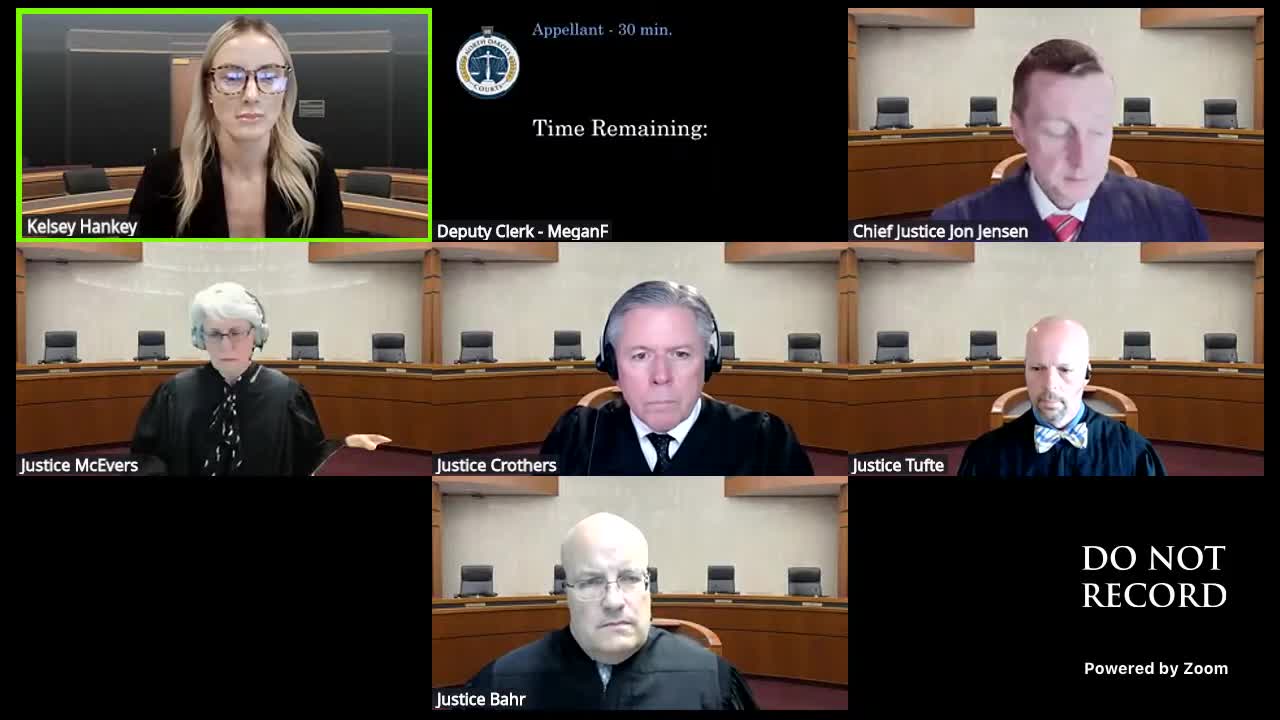
Summary
The North Coast Supreme Court heard oral argument on an appeal asking the court to reverse a district court’s December 2024 denial of a petition for nonparent custody filed by Stacy and Katie Kemp.
The North Coast Supreme Court heard oral argument on an appeal asking the court to reverse a district court’s December 2024 denial of a petition for nonparent custody filed by Stacy and Katie Kemp. Attorney Kelsey Hankey, representing the Kemps, urged the justices to award custody to her clients after the couple cared for the child intermittently from infancy through early childhood.
Hankey told the court the Kemps, the child’s uncle and aunt and the child’s godparents, provided primary care in Grand Forks, North Dakota, for more than two years and sought custody after prior efforts to adopt were not completed. “The district court disregarded the overwhelming evidence in favor of custody with the appellant,” Hankey said, arguing the trial court’s credibility findings and application of the statutory best-interest factors were clearly erroneous.
Hankey summarized the parties’ history: the respondent, Kelsey Quislin, lived in Georgia and at one point told friends she was acting as a surrogate for the petitioners; the biological father, Felix Jackson III, also lives in Georgia. Hankey described repeated requests by Quislin for the Kemps to take the child, a baptism in Grand Forks attended by Quislin, and a period when the child lived with the Kemps from about 17 months old until about 4 years and 1 month old (described in argument as roughly 32 months). The Kemps previously filed for termination and adoption on Sept. 5, 2023, sought an ex parte temporary residential order that was vacated after an Oct. 18–19, 2023 hearing, and later dismissed that termination/adoption case before filing the nonparent-custody petition on Dec. 1, 2024.
Hankey emphasized evidence the guardian ad litem had expressed serious concerns about the child’s welfare while in Quislin’s care and that Jackson filed a declaration supporting the Kemps’ petition. She said the district court nevertheless denied interim and final relief and rejected requests by the guardian ad litem for records and evaluations (medical, mental-health, employment) that Hankey argued were relevant to the best-interest inquiry.
At oral argument Hankey also pointed to procedural facts: a trial originally set for April 18, 2024, was continued to Oct. 2, 2024, based on statements Quislin made to the court, and Quislin was later charged with providing false statements to the court. Hankey told the justices the continuance and Quislin’s admitted false statements were relevant to credibility determinations and the court’s evaluation of the best-interest factors.
The parties’ counsel and the justices discussed the statutory framework. Hankey cited provisions of the nonparent custody statute enacted in North Dakota in 2019 and identified the statutory factors the district court was required to weigh, including the best-interest factors enumerated in the North Dakota Century Code. She argued the record—testimony from the Kemps, limited testimony from a witness for Quislin, the guardian ad litem’s concerns, and Jackson’s supporting declaration—established by clear and convincing evidence that the parental presumption was rebutted or that the statutory factors supported placement with the Kemps.
Justices questioned whether the district court properly weighed the year the child spent with the biological mother and probed the effect of Quislin’s failure to testify at trial and the parties’ competing evidence. Hankey acknowledged the presumption that a parent has custody rights but argued that the district court did not adequately explain or support its factual findings and credibility determinations.
No decision was announced at argument. The court took the case under advisement.