
North Dakota Supreme Court weighs whether state can force dismissal of Medicaid-fraud prosecutions
Get AI-powered insights, summaries, and transcripts
Subscribe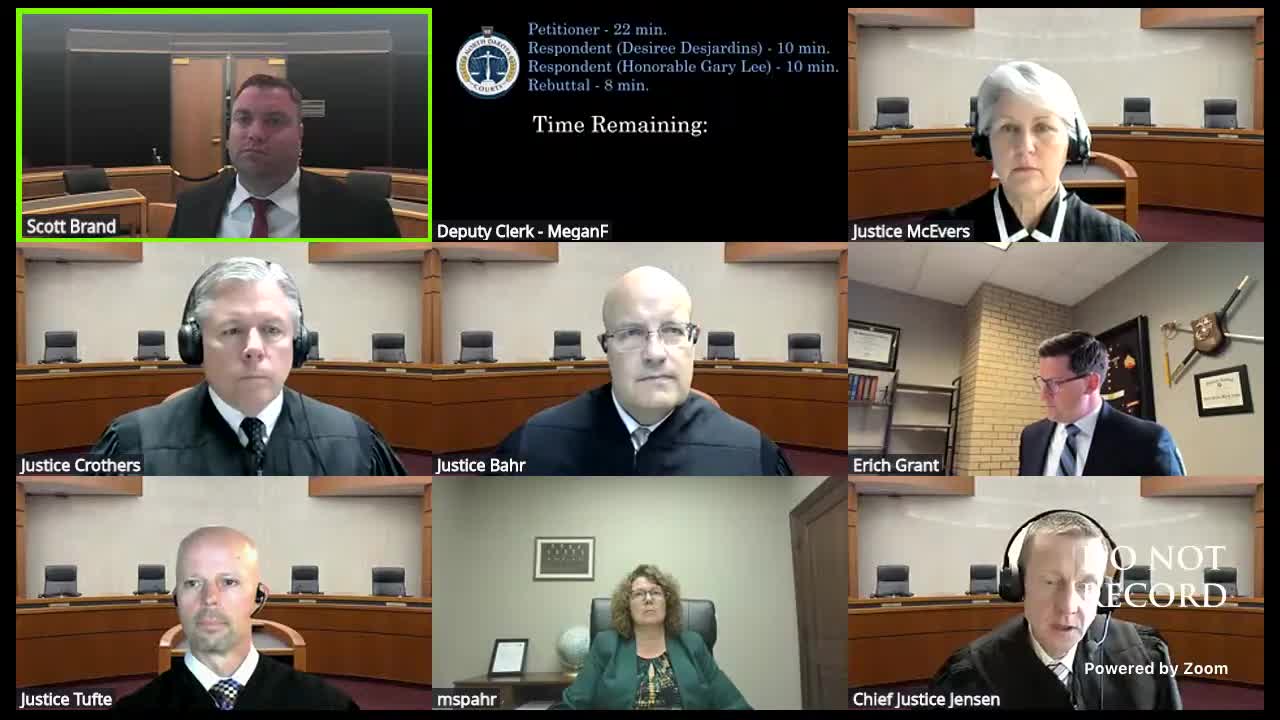
Summary
The North Dakota Supreme Court on Thursday heard arguments on whether it should direct district court Judge Gary H. Lee to grant the State’s motions to dismiss criminal charges with prejudice in two related Medicaid-related matters (file nos. 20250136 and 20250137).
The North Dakota Supreme Court on Thursday heard arguments on whether it should use supervisory jurisdiction to direct district court Judge Gary H. Lee to grant the State’s motions to dismiss criminal charges with prejudice in two related matters (file nos. 20250136 and 20250137) arising from Medicaid-related allegations.
The State, represented by Marina Spahr of the North Dakota Attorney General’s Office and the North Dakota Medicaid Fraud Control Unit, asked the high court to intervene after Judge Lee denied motions to dismiss. Spahr said the district court’s orders rested on what she described as misinterpretations of statutory and procedural authorities and left the State without an appeal. “The state has no right to appeal in this situation, and this is a case of first impression,” Spahr told the court.
The issue matters because, the State said, a civil regulatory agreement negotiated with the defendants provides safeguards the criminal process cannot, including long-term professional restrictions for one defendant. If the State cannot obtain dismissal with prejudice, its remaining options, Spahr said, are to proceed to trial (which she and counsel said is not an acceptable remedy) or seek supervisory relief from the Supreme Court.
Respondent Desiree Desjardins, through counsel Eric Grant, joined the petition for supervisory review and framed the controversy as one that would evade meaningful appellate review if the court declines to act before trial. Grant argued that, absent pretrial relief, the posture of the case would change and the central legal question would likely become unreviewable: whether a district court may deny a prosecutor’s Rule 48(a) motion to dismiss with prejudice in the circumstances presented here.
Scott Patrick Brand, representing Judge Lee, urged the court to remand for further district-court proceedings and to require the parties to pursue alternative remedies before the Supreme Court intervenes. Brand argued the record showed the parties had not exhausted options such as amending charges, pursuing pretrial diversion, conducting an evidentiary hearing to establish the practical and ethical concerns relied on by the State, or seeking another statutory pathway. He stressed that when a prosecutor files criminal charges, the judicial branch acquires a role in the proceeding and that Judge Lee’s interpretation—that civil compromise under North Dakota law applies to misdemeanors and infractions but not to felony-level civil compromise—warrants further district-court factfinding and legal consideration. “When the prosecutor files a criminal charge with the court, the sole discretion of the executive branch ends and the judicial branch acquires a role in the proceeding,” Brand told the court.
The arguments focused on three interlocking legal questions: (1) the scope of the Supreme Court’s supervisory jurisdiction in pretrial criminal matters; (2) the reach of North Dakota statutory provisions the parties discussed (including the statute the parties cited as 29-01-16, which the State says governs compromises in misdemeanor/infraction cases); and (3) the limits of a prosecutor’s discretion under Rule 48(a) of the North Dakota Rules of Criminal Procedure. Counsel debated whether 29-01-16 permits the kind of civil compromise the State relied on in these files and whether the Medicaid Fraud Control Unit may unilaterally proceed to dismiss or compromise felony-level charges that are not charged under the Medicaid-specific chapter the unit enforces.
Justices pressed counsel on practical consequences. One justice asked whether a bench trial in which the State offered no evidence would be an adequate alternative remedy; counsel for the State and for Desjardins responded that deliberately failing to present evidence raised ethical and practical issues and could implicate contempt or other sanctions. Justices also questioned whether victims had been contacted or had agreed to a civil-compromise procedure; counsel representing Judge Lee said the record did not clearly show victim contact in the Desjardins matter and noted that Judge Lee’s orders reflected those statutory and procedural concerns.
Neither the court nor the parties announced a ruling. The oral argument record shows disagreement about whether the parties have tried—and failed—adequate alternative remedies before seeking supervisory review and about the statutory reach of the civil-compromise mechanism the State invoked. The Supreme Court will decide whether to take supervisory jurisdiction and, if so, whether Judge Lee abused his discretion in denying dismissal with prejudice.
File numbers: 20250136, 20250137. The matters discussed involve the State of North Dakota, respondent Desiree Desjardins, respondent Jennifer Napora, and actions by Ward County in proceedings before Judge Gary H. Lee.