
Massport ARTC parking-lot rehab raises stormwater concerns; commission asks for retrofit study and continues hearing
Get AI-powered insights, summaries, and transcripts
Subscribe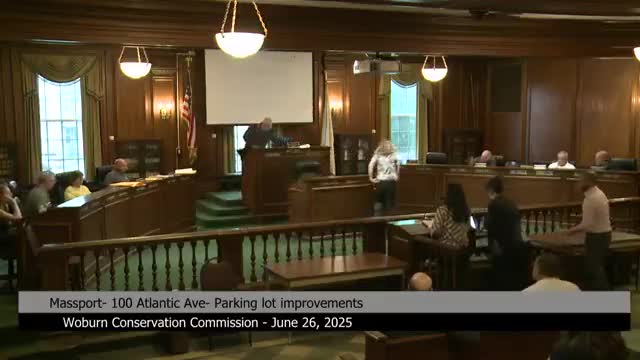
Summary
Massport told the Woburn City Conservation Commission its Anderson Regional Transportation Center repaving is maintenance of a Superfund cap; commissioners pressed for water-quality improvements, asked staff to study potential retrofits at a sedimentation basin, and continued the hearing to July 24.
Mira Lando, a representative of Massport’s environmental unit, told the Woburn City Conservation Commission that Massport is proposing parking-lot rehabilitation at the Anderson Regional Transportation Center to maintain an environmental cap placed under an EPA Superfund cleanup.
Commissioners expressed concern that the rehabilitation — which Massport said affects 112,163 square feet (2.57 acres) of 100-foot wetland buffer — does not include water-quality upgrades to address oil, gas and floatables entering a downstream sedimentation structure. The commission asked Massport to evaluate retrofit options for the sedimentation basin and to supply materials a week before the next meeting.
“This project is just a part of, the ARTC fulfilling that obligation,” Lando said, describing the work as mill-and-overlay, full-depth pavement replacement, drainage repairs, and limited in-place repairs that remain inside the existing parking lot. She said the ARTC sits on a former chemical-manufacturing Superfund site that was capped and that Massport, the MBTA and MassDOT jointly operate parts of the facility.
Massport’s consultants said the updated plan adds a 100-foot buffer to a previously unbuffered feature and shows 112,163 square feet (2.57 acres) of 100-foot buffer impacts. Work described in the application includes replacing two manholes (one within the buffer), replacing and repairing several catch basins (five within the buffer), concrete and brick repairs, re-striping, fence repair and a laydown area within the existing lot.
Commissioners asked whether the catch basins have deep sumps and whether taking catch basins offline would improve water quality. Jeff (last name not specified) and other consultants said the site’s drainage and utilities are limited by the engineered Superfund cap and that the existing catch basins are shallow drop-inlets; deep-sump basins are not feasible because of the cap’s depth and required utility layout. The project team said routine maintenance, including annual cleaning of the sedimentation structure, is part of the stormwater maintenance plan.
Commissioner Launice and others pressed for added filtration or pretreatment at the sedimentation structure so oil and floatables would not pass into the constructed stormwater wetland. The commission asked Massport to evaluate whether retrofits at the sedimentation basin — rather than modifications to shallow catch basins — could provide measurable water-quality improvements.
Chet Myers, deputy director for maritime project delivery at Massport, described the regulatory constraint: “We are operating under very restrictive conditions in this location. ... We could end up reopening the Superfund site, which we would not want to do from a regulatory point of view.” Myers said Massport will examine whether the area near the sedimentation basin has the same restrictions and report back to the commission.
Massport agreed to review retrofit options and to deliver materials to the commission by July 17 (one week before the commission’s July 24 meeting). The commission voted to continue the public hearing to July 24, 2025, so the project team can return with any additional analysis or design options.