
Peer reviewer questions applicant’s calculation of impervious area for Woburn riverfront project
Get AI-powered insights, summaries, and transcripts
Subscribe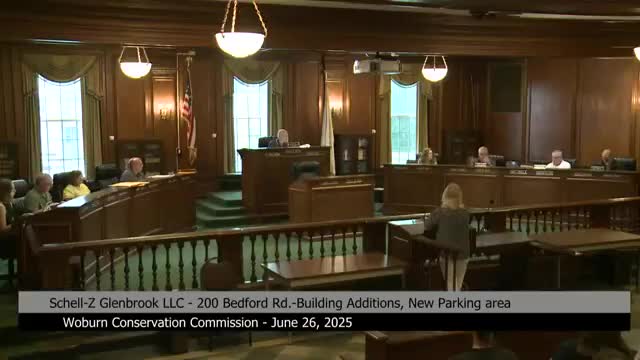
Summary
At a Woburn City Conservation Commission hearing, Linden Engineering and a peer reviewer debated whether crushed stone on a riverfront parcel should count as impervious surface; commissioners closed the public hearing and will schedule a special meeting to issue the order of conditions.
William Jones, a representative of Linden Engineering, and Janet Bernardo, a professional engineer with Horsey Whitten Group, disagreed before the Woburn City Conservation Commission about whether crushed stone on a proposed riverfront redevelopment should be counted as impervious surface.
The dispute matters because local riverfront rules limit disturbance and impervious coverage; the commission’s peer review found the applicant addressed most comments but flagged an unresolved question about exactly which areas are being converted from impervious surface to vegetation.
Janet Bernardo said the peer review team submitted letters on May 12 and June 20 and that “the 1 item that we are still haven't quite understood is exactly where the impervious area is being removed.” She told commissioners the reviewer saw a reduction tied to the removal of a tennis court but could not locate a clear, vegetated area that would replace the existing crushed stone.
William Jones said the crushed stone currently on the site is crushed stone placed over soil and that water will infiltrate through it; he argued the applicant did not consider that material impervious for their calculations and noted the project is replacing pavement with crushed stone in parts of the site. Jones said the parking lot will be smaller than the tennis court and will have a curb required by zoning.
Commissioners and the peer reviewer also discussed native plantings the applicant agreed to place on the embankment and a recommendation to monitor those plantings for a couple of years. Commissioner Jim asked about an integrated pest management plan; Jones confirmed that plan was submitted on April 9 and provided to staff for the commission's review.
Separately, Bernardo noted that the parcel already exceeds the typical 10% allowable disturbance for riverfront area — she described the existing disturbance as “more of 56%” — and that the project's incremental additional disturbance was extremely small (about 20 square feet) and therefore did not trigger additional remedial thresholds.
After discussion, a commissioner moved to close the public hearing and the motion passed. The commission asked whether the applicant would consent to additional time for the commission to issue an order of conditions; the applicant expressed a desire to keep the process moving. The commission said it would schedule a special meeting to sign and deliver the order of conditions.
The record shows the peer reviewer’s remaining concerns center on (1) whether the crushed stone areas should be counted as impervious for the riverfront calculation and (2) confirmation that areas identified as removed will become vegetated. The applicant and reviewer agreed on native plantings in some embankment areas and on most recommended conditions in the June peer-review letter.
The commission closed the public hearing and will set a special meeting to finalize the order of conditions; the petitioner asked that the record show the hearing was closed and that the applicant wishes to proceed without further delay.