
Kirkland planners direct staff to draft co‑living code with hybrid parking standard and no inclusionary requirement
Get AI-powered insights, summaries, and transcripts
Subscribe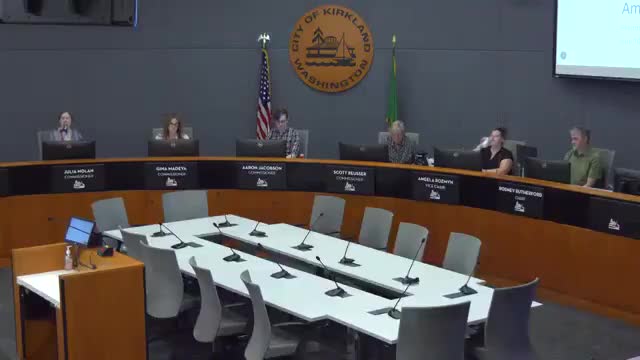
Summary
At a Planning Commission briefing, staff outlined code changes to implement Washington’s co‑living law; commissioners signaled support for a hybrid parking standard and for drafting the ordinance without an inclusionary (on‑site affordable housing) requirement, returning the draft for public hearing.
KIRKLAND, Wash. — Planning staff briefed the Kirkland Planning Commission on proposed code amendments to implement Washington House Bill 1998 and directed staff to draft an ordinance that uses a hybrid parking standard and does not require inclusionary on‑site affordable units for co‑living developments. The briefing, led by associate planner Martha Rhubarb, explained that HB 1998 requires cities to allow co‑living housing as a permitted use on lots where at least six multifamily units are allowed and sets limits on density counting and room‑size restrictions. “Today's presentation is a briefing on the Code Amendment Project and approach for minimum compliance with State House Bill 19 98 for co living housing,” Rhubarb said. Commissioners and staff discussed density, unit configuration, parking, and how existing local rules for “residential suites” overlap with the new state requirements. Under the state law, co‑living sleeping units count as no more than one quarter of a dwelling unit for density calculations; Rhubarb noted that “if the underlying zone allows for seven dwelling units...for co living you could develop four times that number,” subject to other development standards. The law also bars room‑dimension requirements and requires that co‑living be subject to the same review and development standards as other residential uses in the zone. Staff recommended replacing the current residential‑suites use listing with a new co‑living housing chapter that defers most design and bulk standards to the multifamily rules for each zone. On parking, staff offered two options: minimum compliance with the co‑living bill, or a hybrid that also applies the limits from Senate Bill 5184 (the commission previously opted to implement SB 5184 early in other projects). Under the hybrid option staff outlined, parking minimums would be zero spaces per unit near major transit and would incorporate the SB 5184 threshold for units under 1,200 square feet or for affordable units. Commissioners asked about how sleeping units are defined and whether units might include couples; Rhubarb answered that the definition limits a co‑living sleeping unit to a single sleeping space but does not set occupancy limits beyond building code. Vice Chair Angela Rosman, citing local data, said existing developments on the East Side had rents “pretty much all below 70% AMI” and that about “65% of the people living in them right now make below 60% AMI,” comments she gave as background on observed affordability in current co‑living stock. After discussion, staff sought direction on parking and inclusionary (affordable housing) requirements. Allison (staff member) summarized the commission’s direction: the draft code will include option B for parking (the hybrid approach) and will not require on‑site inclusionary affordable housing for co‑living units. That draft will return to the commission for a public hearing and then to City Council for potential adoption per the schedule in the staff report. Discussion vs. decision: commissioners debated policy choices—parking standards, whether to apply existing inclusionary zoning to co‑living, and outreach—without a formal recorded vote; staff recorded the commission’s consensus direction and will prepare draft code that reflects it. The commission did move the topic into the public‑hearing track but did not adopt final regulations at the briefing. Next steps: staff will prepare draft code language reflecting the hybrid parking approach and no inclusionary requirement for co‑living, publish materials for public outreach, hold a planning commission public hearing, and forward a recommendation to City Council for consideration.