
Escambia district previews capital-millage revenue, planned projects and transfers
Get AI-powered insights, summaries, and transcripts
Subscribe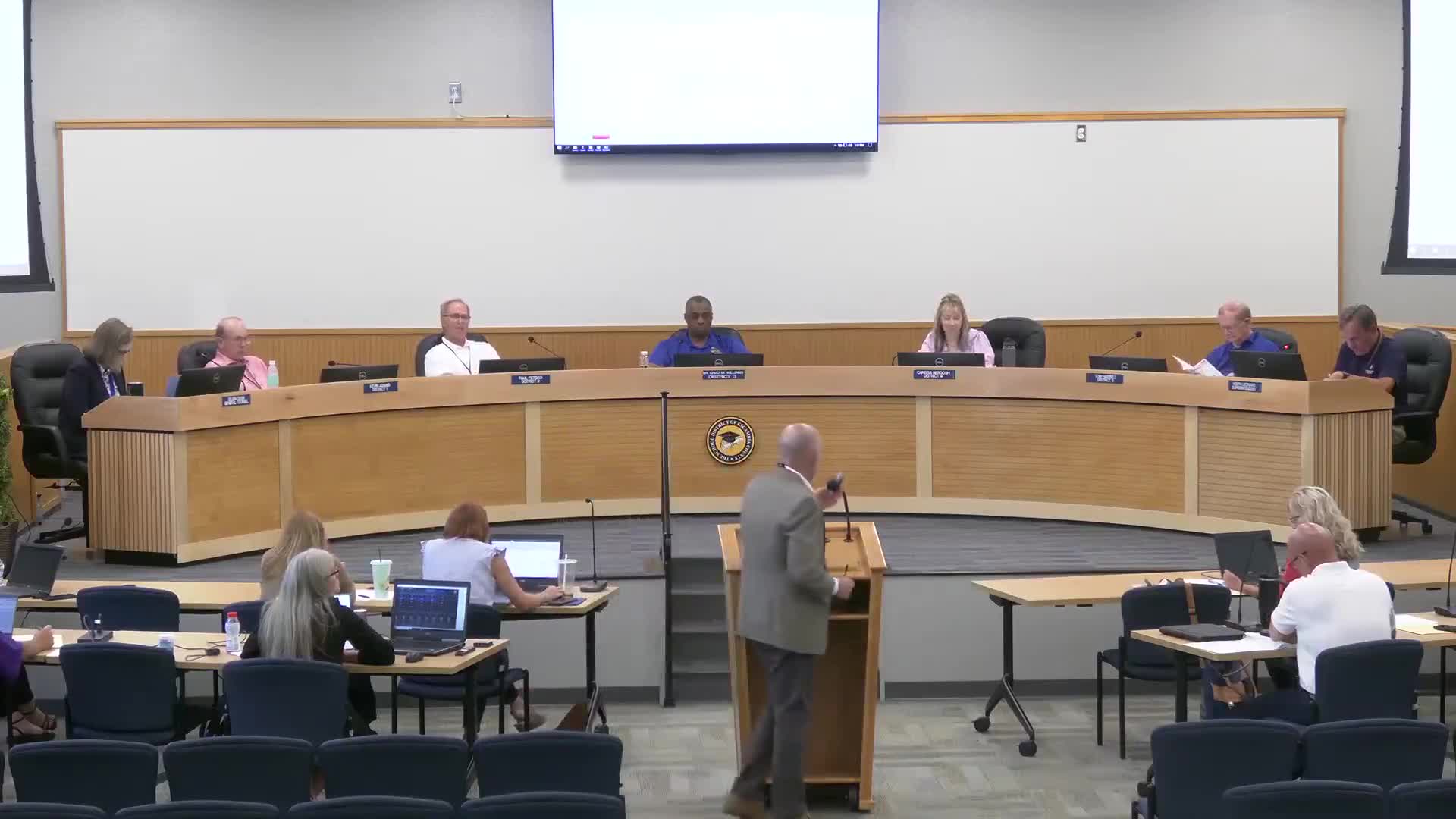
Summary
At a July workshop district finance staff outlined the proposed capital millage plan including revenue estimates, transfers to debt service and insurance, discretionary school and department requests, and major projects such as high-school auditoriums and classroom additions.
Escambia County School District finance staff at the July workshop presented an initial capital-millage plan that pairs preliminary revenue estimates with a list of department and school needs, debt-service transfers and several planned construction projects.
Key figures and structure: Staff projected revenue of about $52 million at a 1.5-mill capital levy on a certified tax roll of roughly $36.1 billion (assuming 96% collection). Identified capital needs and transfers totaled about $48.3 million, leaving an estimated $3.7 million as an ending fund balance or reserve under the district’s preliminary calculations.
Major components shown to the board included: - Department and school replacement cycles (computers, buses, copiers, radios) and discretionary project requests. - Transfers from capital millage to debt service funds for certificates of participation (COPS) and other bonded debt: staff cited $4.9 million (millage portion for series 2020A), $1.8 million (interest-only for series 2023A), and a preliminary $3.1 million estimate linked to a 2025 issuance (series 2025A). Staff noted the district segregates these debt-service obligations into separate funds. - Eligible maintenance transfers from millage into the general fund for work-order–driven maintenance and property insurance (a statutory cap of $200 per unweighted FTE was referenced). - Charter school capital-share payments (60% of the calculated charter share) and an itemized listing of schools eligible for state capital outlay.
Planned capital projects discussed: the district described three major school-construction initiatives to be funded in a bond/COPS program: an auditorium at Escambia High School, a parallel auditorium project at Tate High School, and a gymnasium/“gymatorium” renovation at Pine Forest. A proposed prototypical classroom-addition program would replace portable/modular classrooms at multiple campuses with permanent classroom structures; the design approach uses a prototypical plan customized to match each campus facade.
Finance staff noted some line items remain placeholders — including an unidentified contingency of about $2.5 million for emergency repairs — and said the lists will be refined before final budget action. “The revenue for that at 96% would be $52,000,000. So the $52,000,000 minus the 48, we have about $3,700,000 remaining,” staff said.
Why it matters: The capital millage supports long-lived district assets, scheduled debt-service obligations and recurring replacement cycles (technology, buses, radios). Board members asked staff to scrutinize timing and necessity of discretionary requests given other pressures on district funds and to return refined numbers in time for the formal millage and budget hearings.
Next steps: Staff will continue to refine the list of projects, debt-service estimates and transfers and present a final recommendation as part of the district’s budget process in the coming weeks. The board asked for calculations showing how taking less than the full 1.5 mills would affect revenue and the millage rate; staff said they would provide that figure.