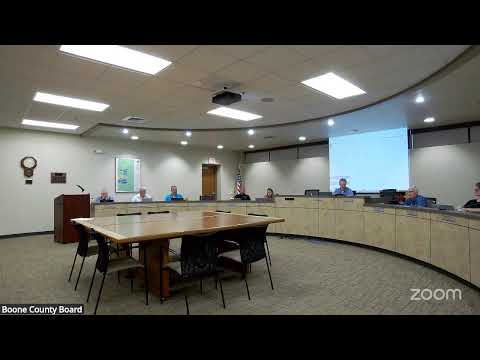
Boone County panel rejects Belvedere Road solar special-use after contested public comment and developer presentation
Loading...
Summary
Developers for a 25‑megawatt solar project east of Belvidere Road presented technical, economic and decommissioning plans, and the Zoning Board recommended approval with conditions; the administration committee declined to approve the special-use permit after public opposition and board concern about scale and farmland preservation.
Developers and their consultants presented plans for an 85‑acre, 25.2 megawatt ground-mounted solar facility east of Belvidere Road on July 10, but a vote of the county’s administration committee failed to approve the project’s special-use permit.
Why it matters: the project would convert roughly 85 acres of agricultural land to a utility-scale solar facility and is proposed on a property that partly borders Winnebago County. Developers said the project would generate an estimated $4.1 million in tax revenue over its operational life, create about 125 construction jobs and provide first-year local revenue of about $174,000, of which about $119,000 would go to the local school district.
The presentation: Ben Jacobi, an attorney for Belvedere Solar LLC, said the company — a Sunco subsidiary — designed the project to comply with Boone County’s solar ordinance and to provide mitigation measures. He said the parcel’s Land Evaluation score (NRI) is 80.3, below the county zoning threshold of 82 that signals higher-quality farmland. Jacobi told the board that Sunco would commit $100,000 to farmland preservation groups in Boone County conditioned on commercial operation, and that the company had signed the Illinois Department of Agriculture’s Agricultural Impact Mitigation Agreement (AIMA), which “is nonnegotiable,” requiring a decommissioning bond.
Sam Dye of Sunco and Michael Krige, the project civil engineer from Kimley‑Horn, presented the site plan, which places arrays outside mapped FEMA flood zones, locates inverters and electrical equipment near the site interior, and adds vegetative buffers along nearby residences. Krige described an interconnection study process under PJM and noted the project would tie to a nearby 138 kV transmission line. Andrew Hartigan of Cohen Reznick presented a market analysis and a review of academic literature; his team found “no consistent negative impact” on nearby residential property values in the cases his firm studied.
Public concerns: two nearby residents, Terry Junenberg and Kirk Swanson, addressed the committee in public comment before the hearing, raising long-term visual impacts (“85 acres of plastic”), the panels’ lifespan and disposal costs, potential effects on property values, and concerns that many developers are not U.S.-based. During the committee discussion, several board members and residents said they were worried about loss of agricultural land, long-term decommissioning certainty, and the project’s scale. One board member asked why solar companies often select farmland rather than repurposing closed landfills or nonfarm parcels.
Zoning Board recommendation and committee vote: the zoning board (CBA) recommended approval with 19 conditions by a 4–1 vote; staff also recommended approval with conditions. The administration committee debated the item at length and then held a vote; a motion to approve the special use failed on a voice vote and the item will appear before the full board.
What was promised: developers said they will provide an agricultural-impact mitigation agreement, a decommissioning bond, vegetative screening, and a pollinator seed mix beneath panels. They also said the project is designed to avoid mapped flood hazard areas and that stormwater effects are expected to be small or neutral if pollinator/high‑rooting plantings are used.
Ending: The committee’s failure to approve the special use in committee does not end the project; the item will go to the full county board. Developers said they remain open to additional mitigation and design changes, and nearby residents asked the board and developers for stronger assurances about setbacks, screening and decommissioning bonds before final approval.