
Escambia board debates stricter rules for instructional and library materials, donor books and committee role
Get AI-powered insights, summaries, and transcripts
Subscribe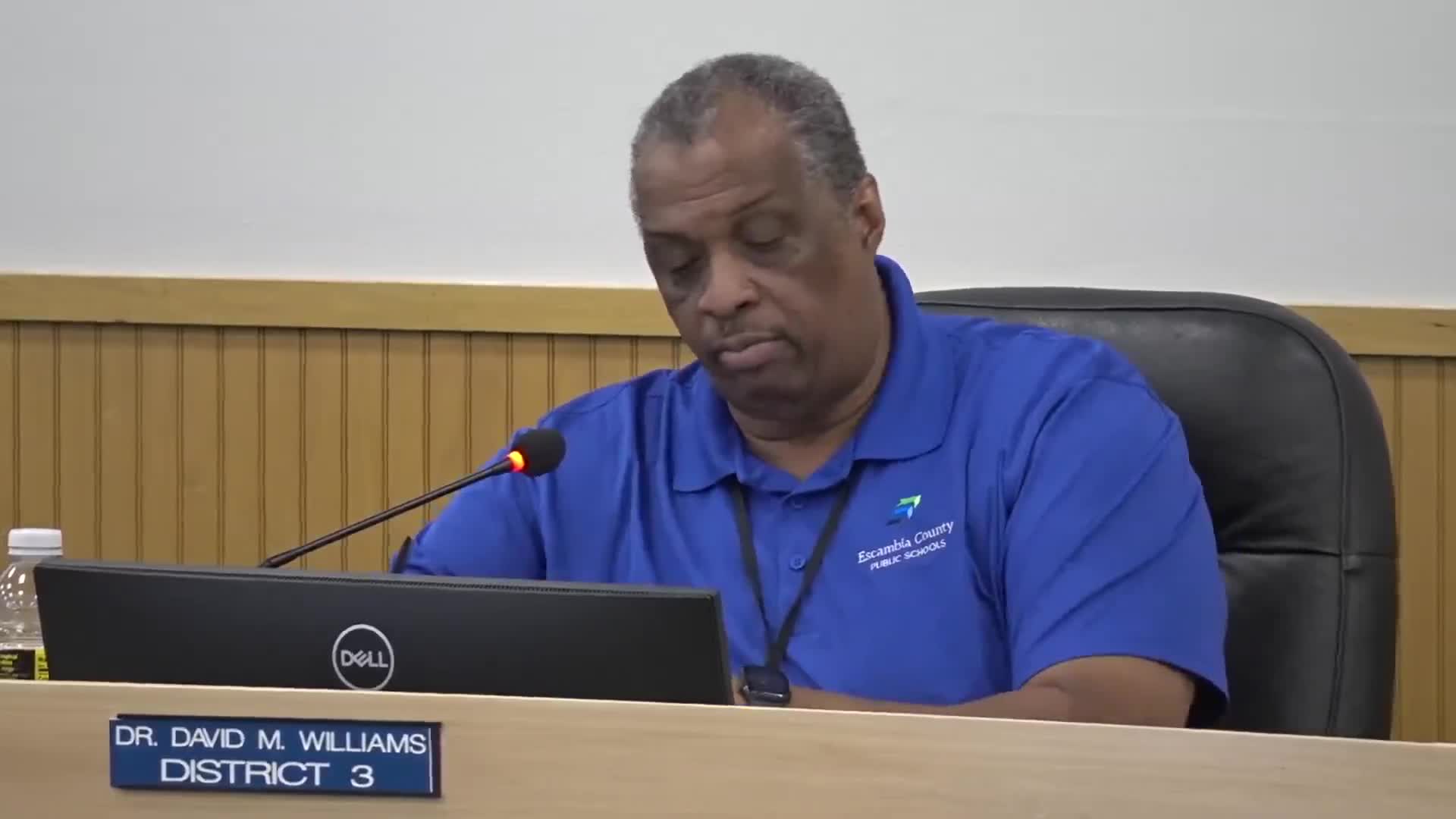
Summary
At a July workshop the Escambia County School Board reviewed proposed revisions to policies 2520 and 2522 to restrict explicit materials in instructional and library collections, add donated items to acquisition rules, and reconsider the role of district book-review committees for challenged titles.
The Escambia County School Board on Friday debated changes to district policies 2520 and 2522 that would tighten selection standards for instructional and library materials, explicitly cover donated materials, and narrow the decisionmaking role of standing book-review committees.
Board members and staff spent more than an hour on page-by-page language in the draft policy, focusing on whether materials removed elsewhere should be automatically excluded here, how to handle books used in AP and IB courses, and whether donated classroom books should be treated the same as purchased items.
Why it matters: The discussion affects what students may access in classrooms and media centers and who — district staff, volunteer committees or the school board — has final authority for contested items. Board members repeatedly stressed they remain legally responsible for materials on school shelves and want a clear, auditable process.
Staff said the revised language would add an explicit prohibition on “explicit” material in adopted instructional and supplemental lists and would repeat that restriction in the section on school library and media center collections so it applies to donated as well as purchased items. “I placed a section under adoption of instructional materials that included language that there would be no explicit material in supplemental, instructional and required reading lists,” said Miss Odom, who led policy drafting for the district.
Board members pressed for clarity on several operational points: whether donated items and classroom-level materials are already covered (staff said they are), whether teachers must complete a form to use outside material in class (staff said certified staff and the principal sign off is required), and how AP/IB required readings should be handled if those titles appear on state or other districts’ removal lists.
Several board members said they want an exception process so that titles approved for use in AP, IB or dual-enrollment courses can be retained with explicit board approval rather than removed automatically if another district has pulled the same title. As one board member put it, in reference to prior decisions on Toni Morrison's The Bluest Eye, “we did a full board review and restricted it to 11th and 12th grade; do we maintain that decision or remove it because another district removed it?”
A separate debate focused on the district review committees that currently vet challenged books. Some members argued the standing committee process has produced outputs inconsistent with later board votes and proposed eliminating standing committees in favor of forwarding disputed titles directly to the superintendent and then the board for final action. Other members recommended keeping committees as a community input resource but tightening their scope and ensuring any committee approval still comes to the board for final sign-off.
Board direction and next steps: The board asked staff to clean up the draft language to (1) explicitly include donated materials and acquisitions in the certification requirement for media specialists and the coordinator of media services, (2) add a clear exception path for AP/IB/dual-enrollment materials to return to board consideration, and (3) propose revised committee language that preserves community input while ensuring final decisions come to the board. Miss Odom said she would incorporate the board’s edits and return with updated language for the formal agenda.
What was not decided: There was no final vote on policy 2520 or 2522 at the workshop; the board debated options and asked staff to bring revised language back for action at a future meeting. Public-comment concerns and a referenced letter from the state attorney general’s office were discussed as context but did not produce board action at this workshop.