
Residents and county officials press for safety fixes after fatal crash at Spring Creek and Shaw Road
Get AI-powered insights, summaries, and transcripts
Subscribe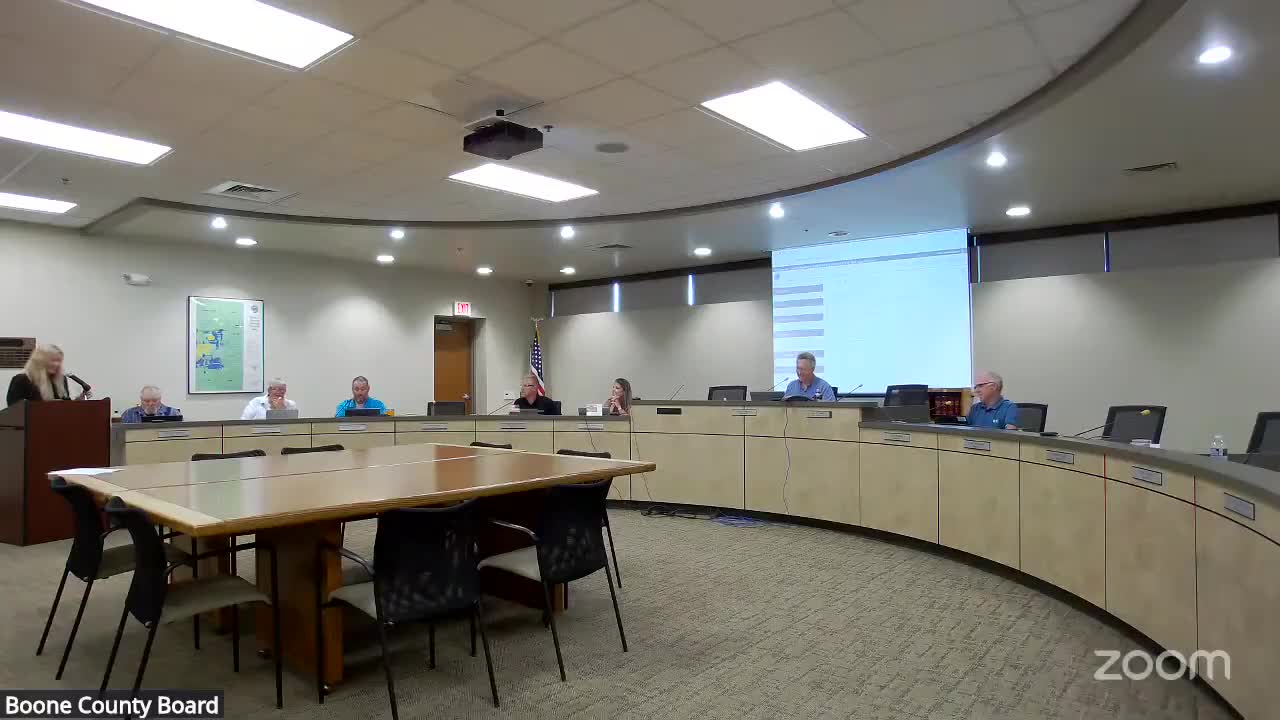
Summary
A Boone County resident told the County Board on July 10 that a recent fatal crash at the intersection of Spring Creek and Shaw Road requires immediate action.
A Boone County resident told the County Board on July 10 that a recent fatal crash at the intersection of Spring Creek and Shaw Road requires immediate action. “We cannot wait for another family to suffer such an unimaginable loss before safety is our number 1 priority,” Katie Bryant said during public comment, asking the board to install a four-way stop and other measures.
County Engineer Justin Cron and the Boone County Sheriff told the committee the county is studying multiple countermeasures and has federal and other grant funding in development for equipment and safety planning.
Why it matters: residents identified repeated near-misses and a recent death at Spring Creek and Shaw as evidence that existing traffic controls are insufficient for current traffic volumes. County staff and law enforcement said they are using crash data and pilot treatments to try to reduce serious injuries and fatalities.
Cron, who said he “provides technical support to all the townships,” described the county’s approach to identifying high-crash locations. He explained the county uses a functional classification—interstates and arterials for mobility, collectors and local roads for access—and that changing control at one point can shift traffic and crash risk elsewhere. Cron said staff have produced intersection “heat maps” from sheriff’s crash reports and are pursuing several pilot countermeasures, including recessed pavement markings (a recessed pattern similar to a rumble strip), additional stop bars and flashing beacons, and a federally funded radar speed-sign program that logs speeds and traffic volumes.
The sheriff described crash patterns the office records and the challenges deputies see in the field. He told the committee a recent serious crash victim was still hospitalized and noted repeated examples where drivers failed to stop or were distracted. “This young lady just got released from the hospital. She’s still on a feeding tube and still in a wheelchair,” he said, describing one long-term case.
What officials said they will try: Cron said the county is running tests of recessed pavement markings at Orth and Caledonia and plans another test at Squaw Prairie and Poplar Grove; he described a tentative design reduction for three proposed roundabouts on Route 76 to a single larger roundabout to reduce conflict points; and he said the county is pursuing federal grants for radar speed signs and an SS4A safety action plan that could unlock further federal funds for countermeasures. The sheriff said deputies and the county’s traffic-reconstruction team will keep enforcement and crash investigation as part of the response.
Community concerns and limits: residents and some board members warned that enforcement and technical fixes only go so far when drivers are distracted or disregard signs. Cron emphasized that lowering speed limits can have unintended consequences if it pushes traffic onto other lower-class roads; he reiterated that design changes should be placed after network-level evaluation. Several members asked for a standing staff-level committee to review crash data and recommended countermeasures quarterly and report back to the board; staff supported a staff-level working group rather than a board-level committee.
Next steps: the highway department will continue pilot testing recessed pavement markings, schedule radar-sign deployments as grants allow, and work with the sheriff’s office on data collection and enforcement priorities. The county will also create a public feedback mechanism to collect road-safety reports.
Ending: Residents asked the county to prioritize physical changes at high-risk intersections while balancing network effects. County staff said they will report test results and grant progress back to the board before larger permanent changes are adopted.