
Boynton Beach commissioners set timeline to form charter review committee
Get AI-powered insights, summaries, and transcripts
Subscribe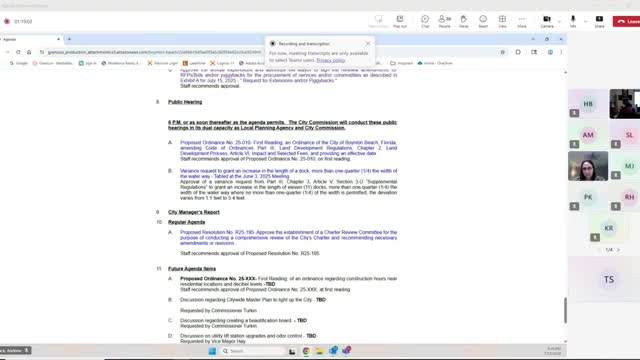
Summary
Commissioners directed staff to create a charter review committee with commissioner-appointed members, a staged timeline for recommendations and possible referendum placement, and agreed to begin formal selections and outreach to the Supervisor of Elections.
The City Commission of Boynton Beach directed staff to establish a charter review committee to study the city charter and recommend any proposed charter amendments that the commission may place on a future referendum. Mayor (name not specified) said the committee would allow the commission to “look at what charter provisions you want looked at,” and described a timeline for selections and review. The commission asked staff to begin documented correspondence with the Palm Beach County Supervisor of Elections about timing and procedures.
Why it matters: changes to the city charter can alter election procedures, residency requirements and other foundational rules that govern city government. The commission’s choices will determine whether proposed amendments can appear on an upcoming referendum calendar and how quickly any changes could take effect.
Commission direction and timeline: The commission agreed that each commissioner will select one committee member, and the commission will ratify those selections on Aug. 5 (staff-proposed date). Staff described a target for the committee to deliver recommendations to the commission by Oct. 21 so the commission could consider whether to submit any measures to a referendum. Shauna (city staff/legal) summarized the procedural approach: the committee will have scope limitations (“bumper rails”) so it can work within the available time, but it will retain the ability to bring proposals forward if a majority of the committee supports them.
Elections timing and Supervisor of Elections: Commissioners and staff discussed the practical and legal limits of referendum scheduling. Maylee, a staff member who reported direct contact with the Supervisor of Elections, said the supervisor “told me straight from her mouth, she told me, no municipal elections, get any referendums or their ballots on the November election unless they actually have a November election.” Commissioners directed staff to memorialize that and other correspondence in writing and to consider the legal options if scheduling disputes arise; a staff member warned that any formal denial of access to a ballot could lead to further legal remedies such as a writ of mandamus.
Committee role and authority: Commissioners emphasized that committee members should be able to operate with some autonomy to propose ideas, while the commission will set high-level areas for review (for example, residency and elections). The commission made clear that any committee recommendation requires a majority vote of the committee before being forwarded as a formal recommendation.
Next steps and public process: Staff said it will prepare an ordinance or administrative steps to form the committee, proceed with commissioner selections for ratification on Aug. 5, seek written guidance from the Supervisor of Elections, and report back to the commission with the committee’s recommendations by the target Oct. 21 date. The commission did not adopt any charter amendments during the meeting; the action recorded was direction to staff and the schedule described above.