
County discusses TIF use, income-tax option and development funding as new projects loom
Get AI-powered insights, summaries, and transcripts
Subscribe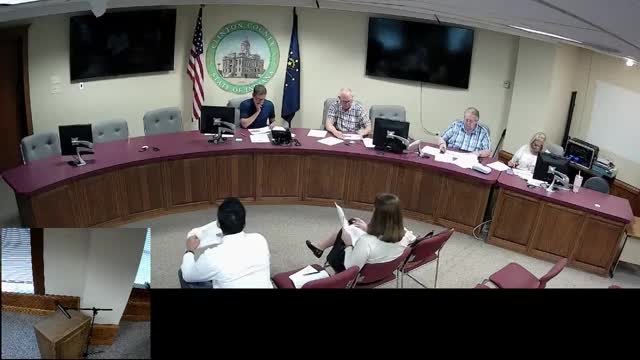
Summary
County officials and staff reviewed tax increment financing (TIF) areas, the option to use newly adopted income taxes for repayment, and funding priorities as major projects including a possible US Organics investment and drainage needs approach the construction phase.
County staff and commission members on May 20 discussed how tax increment financing (TIF) revenues and newly adopted income taxes could be used to pay infrastructure debt on projects such as State Road 28 and County Road 375, while also weighing protections for overlapping taxing units including schools.
The conversation centered on which revenue streams the county might legally and practically use to meet pledged obligations and support future development. Staff noted the county has pledged certain payments tied to infrastructure but “we have not” yet put cash into those pledges, and that the bond documents should list TIF as an allowable payment source, while the county could also use income-tax receipts if needed.
Why it matters: The commission is approaching a period of large potential capital demands — including drainage projects described as “million-dollar-plus,” potential infrastructure tied to an anticipated industrial investment and ongoing road improvements — and officials want to preserve options for financing without creating abrupt impacts to overlapping taxing units such as school districts.
County staff explained that next year the county should begin receiving 50% of city TIF increment for the ConAgra Economic Development Area under an existing agreement that reimburses the county for County Road 375 work. "This was an agreement we put in place to essentially reimburse the county for the cost of putting in County Road 375 to make the ConAgra project happen," a staff member said.
Commission members raised concerns about the mechanics of the new income tax flow. One commissioner asked whether balances currently held in income-tax accounts would be swept into the general fund and whether that would affect certified shares or future levy calculations. Staff said they have not yet received definitive guidance from the Department of Local Government Finance (DLGF) or the State Board of Accounts and suggested that language in the county's income-tax ordinance could specify separate, nonreverting funds (for example, dedicating a portion of an income-tax rate to jail repairs or economic development) to preserve those earmarks.
Commissioners and staff also discussed the effect of TIF on overlapping taxing units. Staff noted state rules limit how much new assessed value TIF captures for overlapping units (the ‘‘30% floor’’ for personal property that remains payable to overlapping units was mentioned) and that TIF does not capture school referendum rates. "If you think about the county, you have a maximum levy...and so if the TIF didn't exist, all of this assessed value would not change the dollars coming in with the exception of lower tax rate," a staff member said in explaining levy mechanics.
Participants reviewed potential uses of TIF proceeds in the district: east‑side interchange improvements, drainage, land acquisition to encourage development, and debt service. A prior spending plan from December included roughly $250,000 to give the county flexibility to contribute toward a payment if desired; staff said they had held back pending tax-reform uncertainty but that the county’s balance appeared healthy.
Drainage needs and preconstruction studies were discussed as prerequisites for major development in multiple quadrants of the TIF area. One county official said Dan Sheets had provided an informational briefing and that specific dollar figures were not available beyond an assessment that the projects would be "million-dollar-plus" in scale. A small preliminary study in one area was funded previously at about $50,000; no new requests for study funding had been submitted at the time of the meeting.
The conversation also covered workforce and education benefits that could be tied to TIF‑funded projects. Commissioners asked whether TIF funds could seed grants or capital improvements for a career technical center (STEM), and staff clarified that TIF cannot pay recurring operations such as salaries or utilities but can fund capital improvements (for example, HVAC repair) and certain grants such as technology purchases.
Several commissioners noted a potential forthcoming request related to a large private investment: staff cited a hypothetical "US Organics" project described as roughly a $400,000,000 investment with about 300 employees; commissioners said such a project could require substantial TIF or matching commitments and might prompt shifting previously earmarked regional funds.
There were no formal votes or ordinance changes at the meeting. Staff committed to several follow-ups: fixing a typographical error in the report and reissuing it to named recipients, running “what-if” fiscal scenarios for new development and the State Road 28/SEA 1 timing, and exploring whether the county’s income-tax ordinance can establish dedicated nonreverting funds to preserve earmarks for jail repairs and economic development.
The meeting adjourned without action on TIF policy or new commitments.
Speakers quoted or referenced in this article are identified generically from the transcript as the meeting did not provide full names for every speaker. Quotations are verbatim from the meeting transcript and attributed to the speaker label that spoke them.
"We wanted the bond documents to show TIF as an allowable payment source," Speaker 3 (Staff member) said, describing the desired flexibility in debt documents.
"The pledge, honestly, was mostly to protect your TIF areas from city annexation," Speaker 1 (Staff member) said when explaining why certain pledges were made prior to cash contributions.
Ending: The commission signaled preference for preserving financing flexibility while staff returns with technical options; no legislative or fiscal commitments were adopted at the session.