
Buellton council adopts adjusted water and wastewater rate schedule after public hearing, sets Nov. 1 start
Get AI-powered insights, summaries, and transcripts
Subscribe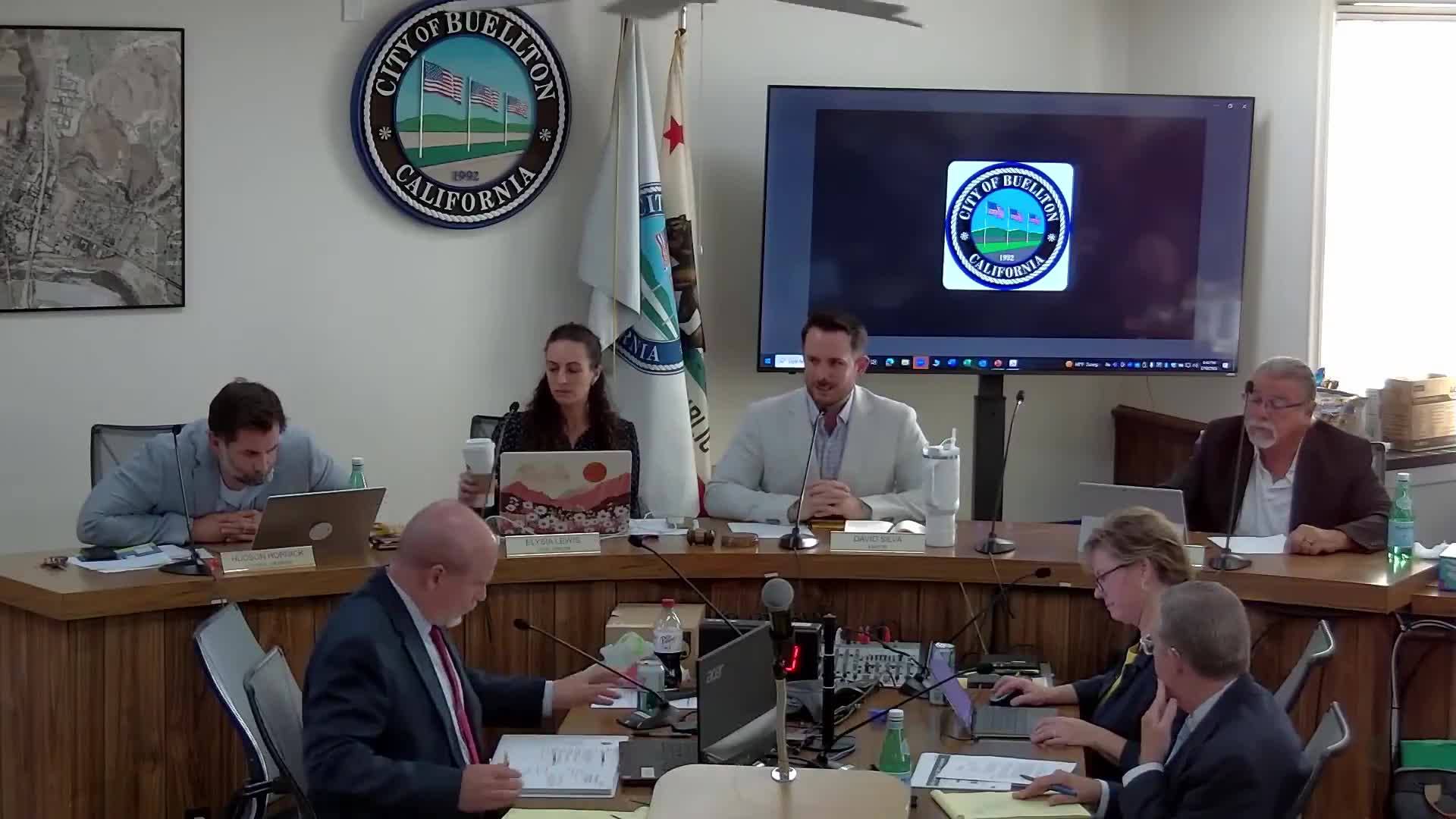
Summary
The Buellton City Council on July 10 adopted a revised five-year maximum schedule of water and wastewater rate increases (Resolution 25-23) and set the first increase to take effect Nov. 1, 2025, after a public hearing and a 3-1 vote.
The Buellton City Council on July 10 adopted a revised five-year schedule of maximum water and wastewater rate increases (Resolution 25-23) after hearing public comment and tallying written protests. The council approved the resolution 3-1, adopting the consultant's alternative 2 schedule as the authorized maximum and setting the initial implementation date for Nov. 1, 2025.
The vote followed a public hearing on proposed monthly meter and wastewater service fees. City staff confirmed the city had received 97 valid written protests by the close of the hearing; that fell well short of the majority threshold needed to block the rate increases (1,084 valid protests required of 2,167 parcels). Vice Mayor Lewis, Council Member Hornick and Mayor Silva voted to approve the amended resolution; Council Member Sanchez voted no.
The city and consultant said the increases are intended to restore enterprise fund solvency, pay for deferred capital work, and meet industry reserve targets. Willdan consultant Chris Fisher presented a five-year financial plan showing the wastewater fund already in deficit and the water fund projected to fall below target reserves within the five-year planning window without rate changes. The capital improvement list included roughly $12.9 million of water projects and about $5.7 million of sewer projects over the next five years.
At the hearing, public commenters — including homeowners, mobile-home park representatives and longtime residents — urged more time to adapt and asked the council to seek grants or loans, to spread increases over a longer period, and to protect fixed-income residents. Several speakers representing Rancho Club Mobile Estates and other mobile-home residents said the proposed changes would be especially hard on seniors and low-income residents and asked the council to preserve the prior additional-unit credit for mobile-home parks. Staff and the consultant said Proposition 218 (the voter-approved rules governing utility rates) constrains rate structures and that prior rate credits lacked a current cost-based justification.
After public comment and a brief recess to accept last-minute written protests, the council adopted the amended resolution. The main changes read into the record and adopted were: to insert the consultant's alternative 2 schedule into Exhibit A as the authorized maximum schedule (attachment 6 to Exhibit A), correct the number of protests received, and set the effective date for the first adjustment to Nov. 1, 2025. Council also directed staff to return with a proposed subsidy/assistance program for income-qualified customers (a CARES-style program) and to present options for the council's annual review of future adjustments during the five-year window.
The formal action (Resolution 25-23, as amended) authorizes five years of maximum rate adjustments and requires council action to adopt each year's actual rate. The consultant and staff noted that alternative 2 phases some increases to reduce the immediate bill shock but projects higher aggregate increases over the longer term; the council accepted that tradeoff when it approved the amendment.
Council members and staff emphasized implementation details would be provided to customers and that staff would pursue available grants and loans but cautioned those sources cannot be relied on to replace rate revenue because of low success rates and the need to repay loans with interest.
Votes at a glance - Resolution 25-23 (as amended): Approved 3-1. Vote record: Vice Mayor Lewis — Aye; Council Member Hornick — Aye; Council Member Sanchez — No; Mayor Silva — Aye. Outcome: approved. Notes: Exhibit A amended to include consultant's Alternative 2 (attachment 6); first increase set to be effective Nov. 1, 2025; staff directed to return with an income-qualification subsidy plan within ~90 days.
What the next steps look like Staff and the consultant will provide billing simulations, outreach materials and a draft assistance program for council review before the Nov. 1 implementation date. The council also asked staff to place a recurring check in future agendas so the city stays on a more regular multi-year rate review cycle.
Ending The council framed the vote as an attempt to balance fiscal responsibility for the city's water and sewer systems with compassion for ratepayers. Staff said it will return with proposed assistance criteria and an implementation plan and will continue to seek outside grant funding where feasible.