
Stowe planners and mayor back ordinance requiring drive‑through bypass lanes after on‑site medical tragedy
Get AI-powered insights, summaries, and transcripts
Subscribe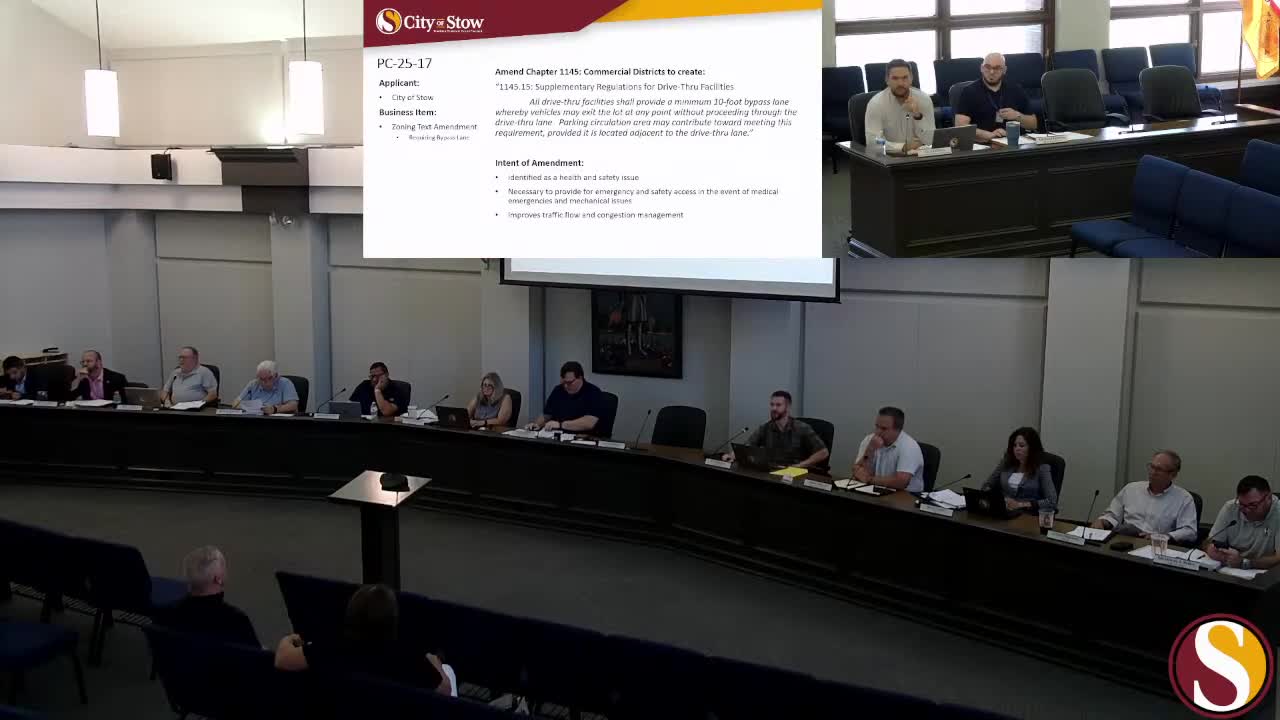
Summary
City planning staff and the mayor told council they will seek a new zoning rule requiring a 10‑foot bypass lane at drive‑throughs after a recent medical emergency at a Graham Road Taco Bell; council set a Sept. 11 public hearing for the draft ordinance.
Planning staff presented a proposed text amendment July 10 that would add a supplementary regulation to the commercial code requiring drive‑through facilities to provide a minimum 10‑foot bypass lane so vehicles can exit the lot without proceeding through a single queue.
The item, filed as Ordinance 2025‑142, is a direct response to a recent medical emergency at a Graham Road Taco Bell that city officials described as a motivating incident. Mayor Provodnikov and planning staff said similar regulations are common in other Ohio jurisdictions and aimed at improving emergency access and site circulation.
Planning Director Zach Cowan said the bypass lane can be a dedicated lane or be satisfied by adjacent parking circulation areas if they provide the required exit path. "They are necessary to provide for emergency and safety access in case there's any medical or mechanical issues while you're stuck in that line," Cowan said.
The mayor noted the proposal follows a local tragedy and said the department has already discussed upcoming redevelopment with Taco Bell, which the city reports is willing to add a bypass lane to a planned new store.
Councilman McIntyre said he intends to support the measure when it returns for final vote. Council set a public hearing for Sept. 11, 2025 at 5:30 p.m. to accept public comment before final adoption.
The draft ordinance remains at the first reading stage; planning staff said the proposal will require the normal three readings and a public hearing before it becomes law.