Get Full Government Meeting Transcripts, Videos, & Alerts Forever!
Get email alerts on the Zoning topic
No spam. Unsubscribe anytime.
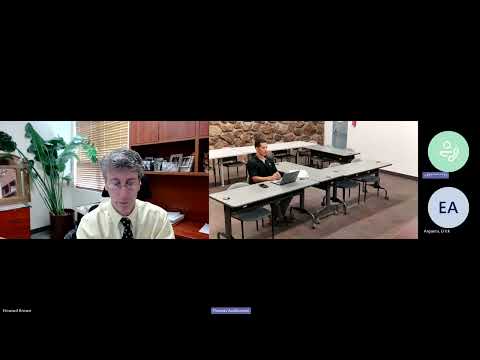
Coconino hearing officer takes Church of Common Good zoning case under advisement after contested testimony
Summary
A Coconino County hearing officer said July 10 he will take under advisement a code-enforcement case alleging unpermitted RVs, structures and refuse at a Winslow property owned by the Church of Common Good; the church invoked religious-use protections and disputed service and some evidence.
A Coconino County hearing officer said July 10 he will take under advisement a zoning-violation case alleging unpermitted recreational vehicles, improvised structures and scattered secondhand materials at a rural parcel near Winslow owned by the Church of Common Good.
The case concerns parcel ID 40685018 at 47775 BNSF Railroad Frontage Road in Winslow, Arizona, a 56.6-acre property the county said is zoned G (General Residential). County code enforcement testified it documented repeated RV occupancy, abandoned or inoperable vehicles, piles of tires and other secondhand materials across inspections beginning in 2024; the hearing officer will issue a written decision after taking the matter under advisement.
County code enforcement officer Mark Stento told the hearing that county records and exhibits show the parcel was used for ongoing RV occupancy and open storage and that the sheriff's office reported people living on the site. "The property is currently owned by the Church of Common Good domestic nonprofit corporation," Stento said, citing an Arizona Corporation Commission listing and county GIS records introduced as exhibits. He testified the county sent notices by certified mail to the church's statutory agent that were returned unclaimed on June 23, 2025, and that Code Enforcement Officer John Cole personally served a notice to appear and related documents on the respondent, Andrew Stevens, during a site contact on June 5, 2025 (exhibit 11, partial body-cam transcript), the county said.
Stento described an inspection history the county recorded: an April 2024 referral from a sheriff's deputy; multiple inspections in late 2024 and early 2025 that showed RVs, travel trailers, "secondhand materials" (including tires and lumber) and makeshift structures; a draft or incomplete 120-day temporary RV permit the church submitted but did not complete or pay; and subsequent inspections in 2025 that, the county said, showed continued occupancy or activity. Stento said the county considers the church's apparent use to most closely resemble a recreational-vehicle resort and that the property, as a residentially zoned parcel, is limited in how it may be used without different zoning or compliance with development and wastewater standards.
Andrew Stevens, identified in the hearing as pastor of the Church of Common Good and a named corporate officer in state filings the county introduced, disputed parts of the county's account and raised two central defenses: that the church's activities are religious worship and ministry protected under the Religious Land Use and Institutionalized Persons Act (RLUIPA), and that some of the county's evidence and service were improper. "The son of man has no place to lay his head," Stevens said in the hearing, arguing the church ministers to people who live in vehicles and needs a retreat-like site to gather them. Stevens also said the church had recently completed purchase of the parcel (a recorded warranty deed shown to the hearing officer) and said some items the county described were either removed (he said the tires were removed) or predate the church's ownership.
Stevens disputed personal-service claims and said he was not the statutory agent. He described receiving notice of the hearing from a church member rather than by the certified-mail packet the county cited, and he objected to the county's attempt to introduce some exhibits at the opening-statement stage; the hearing officer reserved ruling on exhibit admissibility and said he would decide as part of his written order. Stevens also testified about the church's intended use (a spiritual retreat and shelter for traveling congregants), said the church had applied for a 120-day RV permit that was returned for corrections and unpaid fees, and argued that the county had not presented evidence of a public-health risk at the property.
The hearing officer clarified scope: he would consider background facts predating the church's ownership but emphasized he would focus on post-ownership violations for purposes of determining compliance and any remedy. He told both sides the opening and closing statements were not evidence and that he would take the testimony under advisement before issuing a written ruling. "I'm not going to rule right now," the hearing officer said, adding he needed time to consider the issues and would "issue a written ruling as soon as possible" and serve it on the respondent.
No final administrative order was issued at the hearing. The hearing officer invited respectful dialogue between county staff and the church about a path forward before he issues his written decision.
Background and context: Stento summarized a sequence of inspections and notices beginning with a sheriff's-office email in 04/2024, continued inspections and notices to the prior property owner (identified in county records as JMC Land), a warranty deed showing the Church of Common Good took title in early 2025, follow-up inspections in 2025 that the county says documented renewed occupancy or additions, and a citation and notice to appear drafted after a June 2, 2025 inspection. The county introduced multiple photo exhibits (listed on the record) and a partial transcript of body-cam footage from Officer John Cole. Stevens acknowledged that at least one person has stayed overnight at the property since the church took possession and said the church allows short stays for people engaged in ministry or temporary assistance.
Next steps: the hearing officer said he will take the evidence and testimony under advisement and issue a written decision; he noted the decision will be served on the respondent or a church representative and may include instructions or findings that both parties must follow. The hearing officer also encouraged the parties to pursue a cooperative, respectful dialogue about compliance prior to issuance of the written ruling.
Ending: The hearing concluded without a ruling; the hearing officer said he would issue a written decision after further consideration and gave no date at the hearing for that ruling beyond taking the matter under advisement.