Get Full Government Meeting Transcripts, Videos, & Alerts Forever!
Get email alerts on the Planned Development topic
No spam. Unsubscribe anytime.
Commission tables Cardinal Place planned development after residents, commissioners question public benefits and upkeep
Summary
Knox County Planning Commission voted to table a proposed 650-unit planned development called Cardinal Place after weekslong neighborhood opposition and commissioners’ unresolved questions about noise, traffic, maintenance responsibility and whether the project delivers public benefits beyond amenities for future tenants.
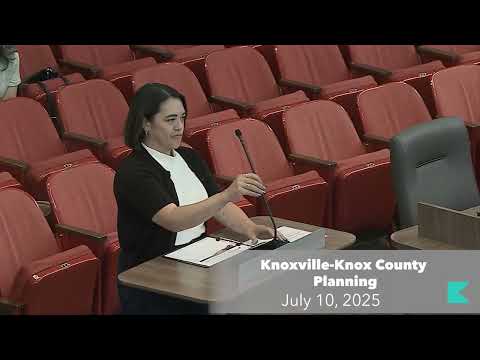
The Knoxville-Knox County Planning Commission on July 10 tabled consideration of Cardinal Place, a proposed roughly 31-acre planned residential development, after extended public comment and a heated commission debate about whether the project’s community benefits would be enough to justify waiving standard zoning rules. The developer asked for the postponement to continue working with staff and neighbors.
Supporters say the plan would add market-rate housing and public amenities; opponents and several commissioners said the promised public benefits appeared aimed primarily at future tenants and lacked enforceable maintenance or access guarantees for the broader community. Developer representatives told the commission they had committed to more than 11 acres of park/open space, roughly 6 miles of walking paths and “five times” the required number of accessible units; they also said the design limits building heights and that some elements would be finalized at the final-plan stage.
Commissioners and speakers repeatedly returned to the core question of planned-development law: does what a developer proposes go beyond what a property owner could build under the underlying zoning, in a way that produces public benefit? Commissioner Gill summarized that question during deliberations: “To me, a planned development is something that is to be necessarily big thinking...something that’s outside of what we could already do in RN‑6. This, to me, just seems like a normal apartment building with the normal amenities that go along with it.” That perspective resonated with officials who said much of the project’s profile could be achieved by a conventional multifamily application in a higher-density district.
Neighbors said the project as currently sited would increase traffic on Del Rose Drive, create public-safety concerns because the area has few sidewalks, and bring noise and parking pressures. A local resident and first‑responder warned the commission the nearby road already sees crashes and that additional vehicle trips would worsen an existing safety problem. Several commissioners and community speakers pressed the applicant to show how amenities would be accessible to neighbors rather than exclusively to residents, and whether the city or a third party would have an enforceable maintenance obligation for parks, trails and courts.
Developer representatives asked the commission for time to work through those points with staff and community representatives and said they would return with clearer maintenance and access commitments. Director-level staff said they had engaged multiple city departments and non‑profit partners and that the applicant had materially revised the plan since the earlier concept review, but staff also pointed to unresolved items in their written recommendation that would need to be addressed before final approval.
After robust discussion the commission approved a motion to table the Cardinal Place preliminary plan; the applicant stated on the record that it will use the continuance to pursue solutions with staff and neighbors.
Commissioners said they expect subsequent submittals to clarify: who would be legally responsible for maintenance of the proposed public spaces; whether amenities are genuinely open to the public and how access would be signed and enforced; specific changes to building siting so steep slopes are avoided; and a parking approach matched to final unit mix. Several commissioners suggested a maintenance covenant tied to the development’s restrictive covenants or a third‑party trust as one way to provide enforceable long‑term upkeep.
The postponement leaves a path forward for the developer, but also formalizes the commission’s expectation that plan‑development waivers deliver demonstrable, enforceable public benefits beyond the private amenities typically included in market-rate apartment projects.