
Board of Appeals approves after-the-fact variance for Holly Point Road property
Get AI-powered insights, summaries, and transcripts
Subscribe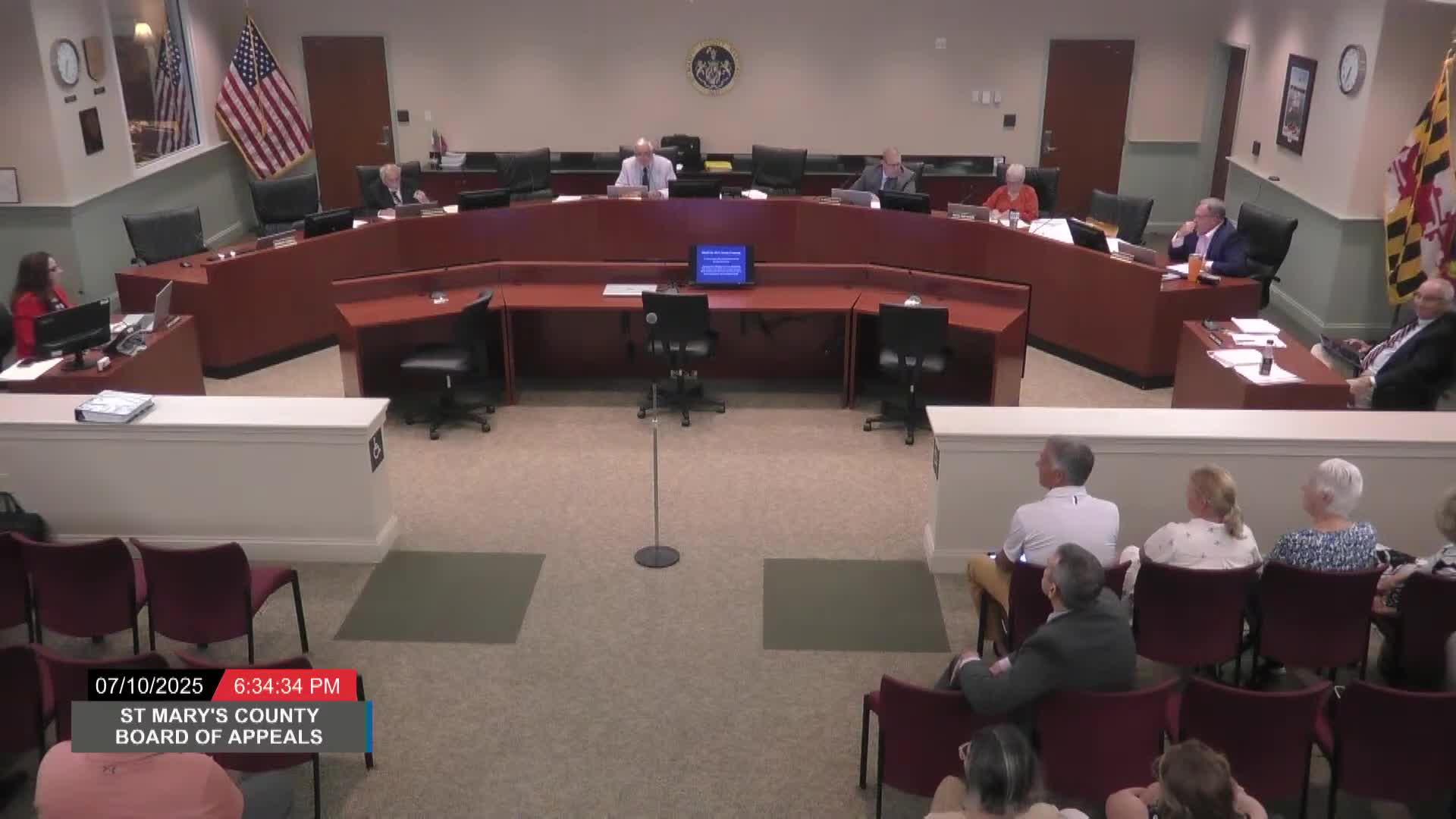
Summary
On July 10 the Saint Mary's County Board of Appeals voted 5-0 to approve a variance allowing after‑the‑fact decks, a shed, and stone revetment work in the 100‑foot critical area buffer for a Holly Point Road property, while requiring mitigation plantings and permitting inspections.
Leonardtown, Md. — On July 10 the Saint Mary's County Board of Appeals approved a variance for the property at 50810 Holly Point Road, authorizing after‑the‑fact decks, a screen porch extension, a shed and stone revetment above mean high water and a proposed new deck, the board said during its meeting in the Chesapeake Building. The board voted 5-0 to grant relief from the county's critical‑area buffer rules for the work described in application VAAP24‑1611.
The decision allows 1,843 square feet of permanent disturbance in the 100‑foot critical‑area buffer surrounding St. Clarence Creek and requires mitigation planting and permitting before final approval. A planting and buffer management plan and a planting agreement must be approved and a bond held for mitigation before a building permit will be issued, staff said.
Why it matters: The property owner sought after‑the‑fact permitting for repairs and additions that had been made without prior county permits. Work in the critical area is regulated to protect water quality and shoreline stability; approvals typically require mitigation plantings and permit inspections. The board’s approval preserves the owner’s ability to keep several of the improvements while imposing the mitigation the county requires.
Staff and applicant summaries: Department of Land Use and Growth Management staff described the site as a 3.11‑acre parcel with the full lot in the county’s critical area overlay; staff recorded the 1,843‑square‑foot permanent disturbance inside the 100‑foot buffer. The Critical Area Commission and the Maryland Department of the Environment were consulted during review; MDE inspectors determined the stone revetment was placed above mean high water and said they observed no violation in the waters of the state, according to staff and the record.
The applicant, Timothy Keefe, told the board the house came into his family after years of decline and that he undertook repairs and reconstruction before applying for after‑the‑fact permits. Keefe estimated the revetment work cost roughly $5,000 and acknowledged county fines and mitigation requirements were part of the process. "I didn't just buy this property on a whim and decide to thumb my nose at the county," Keefe said, describing his effort to restore a family property. Keefe and his consultant said some of the work rebuilt earlier features and that photographs in the record show a previously existing revetment and deck.
Mitigation, permits, and enforcement: Staff and counsel explained the permit path and mitigation calculations. The county requires mitigation plantings calculated at a 4:1 ratio for buffer violations and a separate 3:1 ratio for other disturbance mitigation, producing a combined mitigation burden for the applicant. John Houser, deputy county attorney, told the board that if plantings cannot physically be placed on the property, the applicant has the option to satisfy the mitigation requirement by paying fees in lieu. Staff also confirmed the property is exempt from soil‑conservation and stormwater permitting because the work disturbs less than 5,000 square feet of soil.
Public comment and neighborhood context: Several neighbors testified in support of Keefe, telling the board the prior condition of the house had been an eyesore and that the renovations improved the neighborhood. Neighbors also cautioned the board to consider the scale of mitigation requirements and whether the property could physically accommodate the planting plan.
Board action and next steps: After asking staff for clarifications on acreage and lot‑coverage calculations, the board deliberated and moved to approve the variance as shown on the plans in the record. The board’s order will be prepared by staff and signed within 60 days; the order will carry a 30‑day period for appeal to the circuit court after signature.
Evidentiary notes: Staff entered certified mail receipts, agency comment letters and site plans into the public record. The record includes two MDE letters and the Critical Area Commission comments; the board discussed those letters during the hearing.