
Board reviews TSBA-recommended policy updates including new cellphone and recess rules, virtual education days
Get AI-powered insights, summaries, and transcripts
Subscribe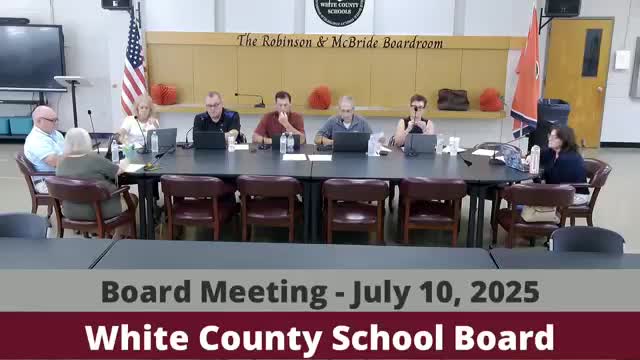
Summary
The White County Board of Education on July 10 reviewed multiple policy updates recommended by the Tennessee School Boards Association to bring district rules into compliance with recent state law, including new restrictions on wireless devices during instruction and a 40-minute elementary recess requirement.
White County — The White County Board of Education reviewed and prepared second readings for several policies July 10 that reflect new state law and Tennessee School Boards Association (TSBA) recommendations, including rules on wireless devices during instruction, required elementary recess time, virtual education days and changes to student progress reporting. Board members and staff said the updates are largely intended to bring local policy into compliance with recent state legislation and to provide required procedural language. Key changes and concerns - Wireless devices: The updated policy follows state law requiring that wireless communication devices be turned off and stored during instructional time unless authorized by an instructor. A staff member explained school-level plans will be included in student handbooks and principals will set classroom-level protocols. "This is a state law. This is not just a strong suggestion from White County Schools," the staff member said. - Elementary recess: The board discussed a legislative requirement for a minimum of 40 minutes per school day of physical activity for elementary students. Several board members and staff expressed concern about where to find instructional time to accommodate the new recess minutes. One board member said, "There is no more time in the day. The legislature has given us way more stuff than we can do in that time." Staff described reworking schedules and combining or condensing transitions as part of the response. - Virtual education days: The board considered a new policy that allows the district and individual schools to plan for occasional virtual instruction days, for example during inclement weather. District staff said they will work with principals and technology staff to define what a virtual day looks like for K–7 students who may not have district-issued devices. - Reporting student progress: The policy change aligns progress reporting with recent legislation by requiring at least one progress report per quarter (previously a 4.5-week standard). The updated language requires including the most recent universal screener and, if applicable, dyslexia screening information at least once per quarter. - Other updates: The board reviewed updates on searches by principals/designees, threat-assessment reporting, internet safety and social-media use by staff, charter school monitoring and surplus property rules tied to federally purchased equipment. Board process and next steps Board members indicated they will take many of the updated policies to a second reading at the regular meeting; several of the reviewed items were included in the consent agenda for adoption. Staff said they will include school-level implementation plans (for example, cellphone protocols and virtual-day procedures) in school handbooks and communicate changes to families. Operational notes and enforcement District staff said principal discretion and designated designees will handle searches and threat-assessment procedures and that social-media use by employees may be reported and addressed under policy. The district will implement per-diem travel reimbursements beginning July 1 to simplify certain staff reimbursements. What was not resolved Board members repeatedly noted that the recess mandate and other legislative requirements compress instructional time. They asked for continued work on schedules and communications to families but did not adopt any local changes that would relieve the district of the new statutory requirements. The board planned to finalize second readings and adopt several updates as part of its consent agenda at the subsequent regular meeting.