Get Full Government Meeting Transcripts, Videos, & Alerts Forever!
Get email alerts on the Road Safety topic
No spam. Unsubscribe anytime.
Utah Local Governments Trust trainer reviews trailer safety basics for local drivers
Summary
Jason Watterson of the Utah Local Governments Trust led a virtual safety briefing covering trailer ratings, hitching, load distribution, lights, tires, and backing techniques; he emphasized a 10% tongue-weight rule, pre-trip inspections and extended following distances when towing.
Jason Watterson, a safety presenter with the Utah Local Governments Trust, led a virtual briefing on trailer safety, saying the topic matters to anyone who tows equipment or recreational trailers. “My name is Jason Watterson, and I've been doing this for quite a while,” he told attendees, noting he has worked with the trust for about 18 years.
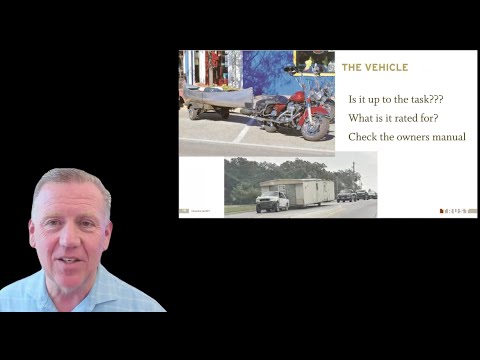
Watterson opened by saying the session was not a Department of Transportation training but that DOT requirements apply to many towing situations. He emphasized that “it is all about the numbers,” explaining that trailers, hitches, couplers and towing vehicles each carry stamped weight ratings and must be matched to the load.
The presentation covered hitch components and fail-safes. Watterson described safety chains as a last-resort device if a trailer separates from its tow vehicle and advised crisscrossing chains so a detached trailer is “cradled” rather than scraping on the road. He also described the need to match the trailer ball to the coupler and to use a pin or clip to secure the drawbar.
On load and weight distribution, Watterson repeated a common rule of thumb: about 10% of the trailer weight should rest as tongue weight on the hitch. He warned that too little tongue weight can cause fishtailing and that weight should be distributed side-to-side as well as fore-and-aft. He advised drivers to stop and rebalance a load if handling feels unstable.
Watterson reviewed tie-down and securement practices. He recommended using rated ratchet straps, chains and load binders rather than twine or baling wire; he said strap breaking strength is typically about three times the stated load limit and that older, sun-worn straps lose capacity. For heavy equipment such as backhoes, he recommended securing each axle and each tool, and adding an extra tie-down for redundancy.
On lighting and electrical connections, Watterson said trailers must have working lights and that drivers should verify correct wiring and connectors — common options include 4-, 6- and 7-pin plugs — before moving a trailer. He told attendees to perform a walk-around pre-trip inspection: check lights, hitch, coupler, chains, tires and that doors or cargo are secure.
He described tire and wheel checks, advising the use of a pressure gauge rather than the “kick” test, and to replace tires showing cords or excessive wear. He also advised stowing the trailer jack before travel and adjusting vehicle mirrors to account for added width and lowered ride height when towing.
Watterson addressed driving technique and braking: reduce speed, allow much greater following distance (start at five seconds for trailers and add one second for every additional 10 feet of vehicle length), use a tow/haul mode if the vehicle has it, and gear down on long descents to avoid overheating brakes. He warned that electric trailer brakes can lock if misused and recommended practicing brake gain adjustments in a safe area.
On backing, he recommended planning the approach, starting with vehicle and trailer straight, making small steering inputs and using a spotter when available. He summarized practical safety basics: do not allow riders on trailers, use three points of contact when mounting or dismounting, and use ladders or steps rather than jumping.
The session closed with Watterson urging attendees to “practice” and to treat towing as the driver’s responsibility. Mike, a staff member who assisted during the webinar, told Watterson, “You look you look good, Jason.” Watterson thanked participants and reiterated the core advice: match ratings, secure loads, inspect the trailer, and drive more slowly and with longer following distances when towing.
This presentation was delivered as a safety briefing and did not include or result in any formal actions or policy changes by the Utah Local Governments Trust.