
Waterbury schools report modest reading gains as district rolls out new curricula and assessments
Get AI-powered insights, summaries, and transcripts
Sign Up Free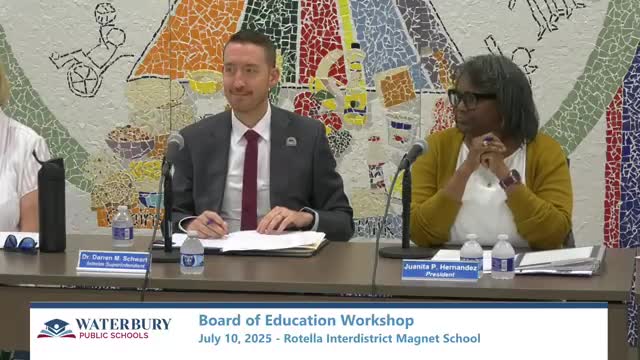
Summary
Interim Superintendent Dr. Schwartz summarized this year’s rollout of districtwide ELA and math materials, pilot plans for OpenSciEd science and K–8 math procurement, and a 4 percentage point rise in proficiency on the district’s MCLASS measure.
Interim Superintendent Dr. Schwartz told the Waterbury Board of Education on July 10 that the district implemented new English language arts programs this year and began districtwide supports intended to raise reading achievement. “4% is a pretty nice gain,” she said referring to the district’s change in proficiency on MCLASS, the district’s benchmark assessment administered three times a year.
The district adopted Benchmark Advanced as the K–5 core ELA program, with Benchmark Adelante for Spanish bilingual students, Benchmark Express for English learners, and Steps to Advance as an intervention for language comprehension. Dr. Schwartz said the district paired new materials with professional development, literacy coaches in each elementary school and enhanced core reading instruction strategies such as ECRI (explicit, systematic routines for phonics, fluency and vocabulary).
Dr. Schwartz cautioned the board not to infer causation from the single-year data. “Can we say it was based on the new program? We really can’t tell that yet,” she said, adding that keeping the same assessment (MCLASS) will help measure year-to-year change going forward.
For secondary ELA, the district adopted My Perspectives from Savvas Learning and reported work this year to train teachers on scaffolds to support adolescent reading comprehension and classroom tasks to make student thinking visible. The secondary program used Savvas assessments this year, meaning staff do not yet have year-over-year growth comparisons tied to prior measures.
On science and math, the district plans a pilot of OpenSciEd (an open educational resources curriculum aligned to NGSS) in grades 4–6 next year and is continuing a K–8 math procurement started this summer to move toward a common K–8 program. Dr. Schwartz described the proposed K–8 math selection as diagnostic-based and “highly correlated to Smarter Balanced,” saying a student finishing the year in the program’s top band historically has a 90% likelihood of being proficient on Smarter Balanced.
Board members asked about teacher buy-in and special-population supports. Dr. Schwartz said special-education and multilingual educators received additional training and that the district purchased Benchmark Hello for newcomer bilingual students midyear. She said expanded interim assessments and continued Benchmark coaching will be used to measure impact next year.
District leaders said statewide Smarter Balanced results will be released soon and that the district will continue monitoring assessment data and professional development needs.