Get Full Government Meeting Transcripts, Videos, & Alerts Forever!
Get email alerts on the Economic Development topic
No spam. Unsubscribe anytime.
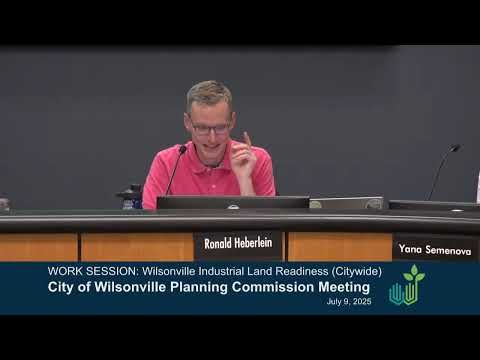
Wilsonville planners review industrial land inventory and favor state employment forecast for 20‑year planning
Summary
Planning commissioners reviewed a buildable lands inventory and four employment‑growth scenarios July 9, finding about 366 acres of unconstrained employment land (mostly industrial) and expressing a preference for the Oregon Employment Department’s 0.85% annual forecast to guide the Economic Opportunities Analysis.
Wilsonville Planning Commission members on July 9 reviewed draft results of a citywide buildable lands inventory and an economic inventory that will feed an update to the city’s Economic Opportunities Analysis (EOA), and signaled a preference for using the Oregon Employment Department’s 0.85% annual employment growth forecast to guide 20‑year land‑need planning.
The work session matters because the EOA is used to comply with state planning rules and to guide infrastructure, zoning and investment decisions that determine whether Wilsonville will have enough development‑ready land for future industrial and commercial growth.
City staff and consultants presented two technical products: a buildable lands inventory (BLI) showing about 366 acres of unconstrained, buildable employment land inside the city and its portion of the Metro urban growth boundary, and an economic inventory with four employment growth scenarios. Nicole Underwood of Eco Northwest described the BLI methodology, saying the study area includes lands with commercial, industrial and town‑center comprehensive plan designations plus an undesignated railroad area being planned for industrial uses. Consultants removed mapped constraints such as floodplains, steep slopes, Title 3 stream and floodplain protections, and habitat conservation areas to arrive at the unconstrained acreage. Underwood noted most of the 366 acres—about 96%—is designated for industrial use, and the city has only about 13 acres of vacant, unconstrained commercial land but additional commercial capacity through redevelopment opportunities in Town Center and reuse of large vacant buildings.
Commissioners pressed for more detail on how much of the mapped industrial acreage is truly vacant versus partially vacant. Beth Goodman (joining by Zoom) said the team maps partially vacant parcels as whole tax lots for clarity, but the analysis counts only the undeveloped portion and that staff can provide a follow‑up map that clearly differentiates vacant from partially vacant acreage. Goodman also explained why slopes greater than 15% were treated as constrained, saying, "It's a standard we've used around the state for a long, long time," and that such slopes are generally unsuited to industrial development.
On the economic side, consultants presented four 20‑year employment scenarios (2026–2046) and how each translates to land need. They reported two employment totals for 2023 used in different parts of the analysis: about 23,100 covered jobs (jobs covered by unemployment insurance) and an estimated total employment base of roughly 32,800 when uncovered jobs are included. The growth scenarios were: - Metro urban growth report: 0.42% annual growth (~2,900 new jobs over 20 years); - Oregon Employment Department (OED): 0.85% annual growth (~6,200 new jobs); - Wilsonville historic rate: 1.03% annual growth (~7,700 new jobs); - Household growth rate: 1.2% annual growth (~9,100 new jobs).
Using the OED 0.85% rate, staff estimated total employment land need of about 439 acres over 20 years (roughly 327 acres industrial and 112 acres commercial). At the higher historic rate, land need rises to about 543 acres (405 industrial, 138 commercial). Consultants emphasized that while Wilsonville probably has sufficient industrial land to meet lower growth scenarios (OED or slower), the city may lack development‑ready industrial parcels to support higher growth rates without infrastructure investments, land aggregation or policy changes.
On potential actions to increase development readiness, Matt Lorenzen, the city’s economic development manager, described a concept the city will present to City Council: using Coffee Creek urban renewal funds not only for infrastructure but to acquire and aggregate parcels to make larger, development‑ready tracts and then position them for private development. Lorenzen said the city would seek reimbursements through Business Oregon programs when appropriate; he framed the idea as proactive facilitation rather than the city becoming a long‑term developer.
Commissioners generally favored the OED forecast as a reasonable midline for planning, noting tradeoffs if the city chooses a rate that is too optimistic (risk of overbuilding infrastructure) or too pessimistic (risk of slow policymaking and missed opportunities). Several commissioners asked staff to include in the forthcoming economic development strategy more concrete implementation items—such as staffing, financing tools and specific infrastructure steps—needed to unlock partially developed or fragmented parcels in Coffee Creek and Basalt Creek.
There were no public hearings or emailed comments on the topic during the meeting. Staff said the project will go next to City Council on Aug. 4, then to stakeholder interviews, focus groups and additional technical advisory meetings, with a full draft EOA expected in late fall.
Votes at the meeting were procedural. The commission approved the June minutes as distributed (voice approval recorded with no corrections) and later adjourned the meeting; the record does not show roll‑call tallies for those motions.
The city packet includes the BLI memo (attachment 1) and the economic inventory and potential growth forecast memo (attachment 2). Staff asked commissioners whether they had clarifying questions about the BLI or preferred a growth rate; commissioners generally indicated a preference for the Oregon Employment Department 0.85% scenario as the planning assumption.