Get Full Government Meeting Transcripts, Videos, & Alerts Forever!
Get email alerts on the Wastewater Treatment topic
No spam. Unsubscribe anytime.
Council approves Strand contract to oversee $55 million wastewater upgrades
Summary
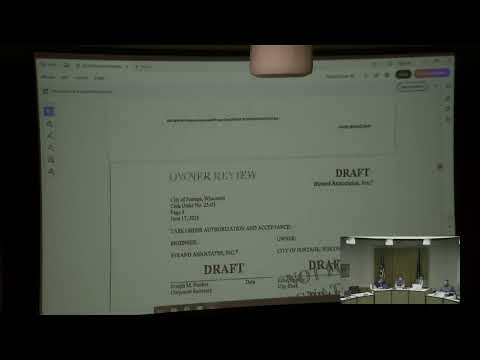
The Portage Common Council approved a $3.936 million construction‑services task order with Strand Associates to manage bidding, construction observation and start‑up for a roughly $55 million wastewater treatment plant upgrade aimed at meeting new DNR limits and future growth.
The Portage Common Council voted to enter a $3,936,000 construction‑services task order with Strand Associates, moving the city’s planned wastewater treatment plant upgrades toward bidding and construction.
The work responds to aging 1980s infrastructure, expected new Wisconsin Department of Natural Resources (DNR) phosphorus and future nitrogen limits, and projected flow increases. City staff and Strand presented the project design and a recommended construction supervision agreement before the council vote.
Strand Associates completed the plant‑wide design and has submitted plans to the DNR for review. Phil (staff member) said the city contracted with Strand in 2021 for a facilities plan and that the council selected an option in 2023 to move to aerobic digestion and Class A dried biosolids. Evan Hunsanger of Strand Associates said, “The site was as a early 19 eighties construction, served the city for 40 years here, and it's just, it's aging.”
The overall opinion of probable cost presented to the council is about $55 million, with anticipated contractor bid day construction costs just under $48 million and the remainder for engineering, geotechnical and legal services. Strand outlined major elements of the design: two large oxidation ditches to replace rotating biological contactors, two deeper final clarifiers, reuse and repurposing of existing primary clarifiers as fermentation reactors, new return‑activated‑sludge pumping, aerobic digestion to replace anaerobic digesters, an on‑site dryer to produce Class A biosolids, and a storage silo for the dried product. Strand identified a Commline Sanderson dryer as the selected manufacturer in preliminary discussions.
Council members asked about schedule, bidding competition and contract terms. Strand said the city would advertise bidding documents in the coming week, with bids to open in mid‑August and construction spanning roughly three years, targeted to reach substantial completion in September 2028. Strand said manufacturers will perform equipment start‑ups and that the consultant will observe start‑up and provide operator training; Strand estimated that start‑up support and follow‑up help could extend for about six to 12 months after turnover and that the project carries a one‑year contractor warranty period.
The approved task order covers bidding services, contract administration, review of hundreds of contractor submittals, monthly schedule and pay‑request reviews, resident project representative (RPR) on‑site observation during construction (Strand anticipates a full‑time representative), start‑up and training assistance, operation and maintenance manual preparation, SCADA integration and loan‑assistance services (for DNR/Clean Water Fund disbursements and related review). Strand noted some construction‑phase services are billed hourly and subject to not‑to‑exceed limits in the task order; council members asked that staff approve hours before larger expenditures.
A council motion to enter the contract was made by Alderperson Green and seconded by Alderperson Wetzel. The council recorded the motion as approved by roll call.
The council also discussed a separate technical services agreement used to demonstrate Strand’s qualifications; staff said that agreement will be administratively extended to cover the near term and revisited later in the project.
What’s next: staff will proceed with advertising the project, answer bidder questions through Strand during the procurement window, and return to the council if additional task orders or approvals are needed as construction progresses.