
Augusta charter review panel outlines options for form of government; residents press for guardrails, clearer outreach
Get AI-powered insights, summaries, and transcripts
Subscribe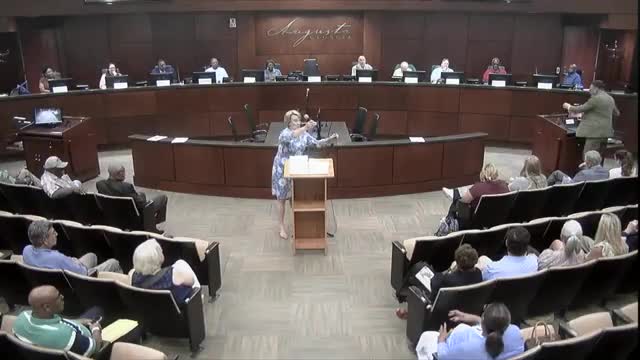
Summary
Dr. Facer of the Carl Vinson Institute told a public hearing of the Augusta-Richmond County Charter Review Committee that the committee is conducting a comprehensive review of the county charter and has begun recommending deletions of outdated or duplicative language.
Dr. Facer of the Carl Vinson Institute told a public hearing of the Augusta-Richmond County Charter Review Committee that the committee is conducting a comprehensive review of the current charter and will consider whether to propose an amended or new charter for submission to the local legislative delegation and, potentially, the General Assembly.
The committee has met biweekly, convened subcommittees on finance and form of government and has begun voting on preliminary recommendations; Dr. Facer said the committee has approved removing ‘‘anticipatory’’ language that described future actions already taken, excising verbatim sections of state law that duplicate state code, and recommending that provisions better suited to ordinances be removed from the charter.
Why it matters: changes to the charter define how Augusta-Richmond County allocates executive and legislative authority, how municipal officials are appointed or removed, and what matters must be decided by ordinance rather than in the charter. Those choices shape who makes day-to-day decisions, how accountable officials are, and how the public participates in local government.
Panel presentation and staff work Dr. Facer described the charter as a ‘‘constitution’’ for Augusta Richmond County and reviewed three broad models the committee is weighing: a ‘‘strong mayor’’ model in which the mayor holds primary executive authority; a ‘‘weak mayor’’ or mayor-commission model where the mayor has largely ceremonial duties and the commission shares executive control; and a commission-manager model in which a professional manager executes day-to-day operations under commission policy direction. He distinguished managers (typically appointed by the governing body and given broader hiring/firing and budget authority) from administrators (who typically have more limited independent authority and may report to a mayor or the commission). Dr. Facer said the institute is preparing a systematic review of academic research and updated data from national associations to support the committee’s deliberations.
Public comments and themes Residents and civic leaders who spoke at the hearing pressed several recurring themes: keep the charter review neutral and transparent; preserve legal safeguards (including adherence to the Georgia and U.S. constitutions); require strong public outreach; and build ‘‘guardrails’’ if the committee considers expanding mayoral authority.
Moses Todd, a resident of Dean’s Bridge Road, argued the charter itself ‘‘calls for a super majority’’ for changes and urged the committee to follow any supermajority requirements in the charter and state law. Marion Williams, a former commissioner, criticized the three-minute public-comment limit and urged more time for deliberation. Reverend Anthony Booker, pastor and leader of the Baptist Ministers Conference of Augusta, urged the committee not to grant the mayor additional veto power and warned that concentrating power without guardrails risks fiscal and managerial problems: "I want you ... to not to give ... the mayor, more power or veto power," Booker said.
Lauren Dallas, executive director of Augusta Tomorrow, told the committee that interdepartmental accountability problems and slow execution of routine work—litter removal and maintenance among them—are hampering downtown revitalization and that clearer lines of operational authority might improve results. "It is very difficult to get some of these things done ... there's little accountability," Dallas said.
Several commenters said the committee must improve outreach and public access to materials. Robert Gentry and others said the charter text and related materials are hard to find on the city site; committee members said documents and meeting videos will be posted at augustaga.gov/crc and that a marked-up draft already will be available online. The committee reported the public survey had received more than 800 responses as of the morning of the hearing and answered that the survey will remain open through July 31 and that aggregated results will be presented publicly.
Concerns about process and representation Speakers raised questions about voter turnout, commissioner attendance, and the number of commissioners. Ben Hassan and others urged the committee to ‘‘follow the rules’’ and to be transparent about whether committee recommendations require simple or supermajority approval. Sheriff Eugene Brantley and others said local agencies and residents often experience gaps in communication and accountability that hinder service delivery. Multiple speakers urged the committee to prioritize communication strategies that reach different age groups and communities and to make materials, slide decks and data more accessible.
Next steps Committee members said Carl Vinson will present comparative data and literature reviews to the form-of-government subcommittee and the full committee; committee meetings are open and continue on a biweekly basis. The CRC has scheduled at least three public hearings in different county locations; staff said all committee materials, meeting video and the survey will be posted to augustaga.gov/crc for public review. Any final charter language the committee forwards will go to the local legislative delegation; if the delegation submits language to the General Assembly and it becomes law, the resulting charter changes would be subject to a local referendum per state procedures.
The hearing closed with committee members asking residents to complete the online survey, share information with neighbors and participate in future public sessions so the committee’s work reflects broad public input.