
Lompoc Planning Commission adopts updated Safety Element after changes; commissioners delete two seismic policies
Get AI-powered insights, summaries, and transcripts
Subscribe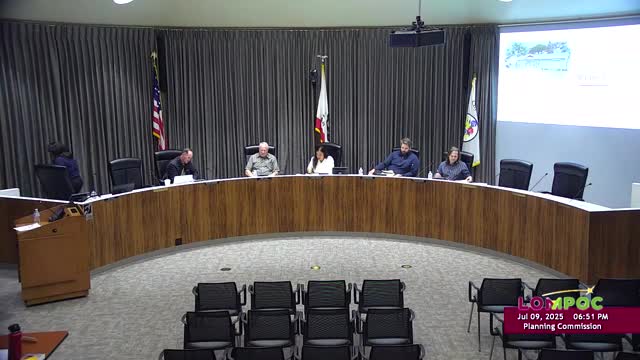
Summary
The Lompoc Planning Commission reviewed and recommended adoption of the updated Safety Element for the 2030 General Plan at a public hearing on July 9, 2025, and approved a resolution forwarding the updated document to the City Council with edits recorded at the meeting.
The Lompoc Planning Commission reviewed and recommended adoption of the updated Safety Element for the 2030 General Plan at a public hearing on July 9, 2025, and approved a resolution forwarding the updated document to the City Council with edits recorded at the meeting.
Laurie Tamora, the city’s contract planner, described the Safety Element update as required by state planning law and triggered by recent updates to the housing element, the local hazard mitigation plan and climate-change requirements. Tamora said the document incorporates technical reviews by Cal Fire and added measures required by state review. “Measures 14 through 22 were added by the direction of CAL FIRE,” Tamora said, “and those are mostly in regards to fire safety, wildfires, hazards, and working requirements… Measures 32 to 39 were added to address climate change and the resiliency… and measure 44 was added in regards to consistency with the airport land use plan.”
Commission discussion focused on neighborhoods with a single access point, the status of the Badger Meadows (sometimes referenced as “Bodger Meadows”) project and several policy and measure edits proposed in a redline draft. Tamora and staff identified multiple hillside neighborhoods and a mobile home park with single-entry access and explained the city had requested additional access points from the county for the Badger Meadows project. Tamora said Badger Meadows is outside the Lompoc city limits and is being processed by Santa Barbara County under a builder’s remedy procedure; the city is a responsible agency and has asked that the project include three access points when annexed.
Commissioners debated seismic-safety language in the draft. One commissioner moved to delete policies 4.2 and 4.3 (which addressed identifying historic seismically vulnerable buildings and public awareness programs) on the grounds those topics were already addressed in state building codes and related requirements. After discussion, members voted to remove policy 4.2 and to subsume aspects of 4.3 into policy 4.4; the removal and related edits were recorded as part of the set of changes staff attached to the resolution.
Commissioners also moved to remove policy 5.1 (concerning public information on landslides) and made other targeted edits to measures concerning wildfire response, building standards outside specific fire response time thresholds and radon/testing requirements; staff and the city attorney clarified that some specifics will be implemented through subsequent code or ordinance changes and that the Safety Element’s measures provide policy direction.
Assistant City Attorney Bethany Burgess advised the commission on procedural questions and on the legal effect of removing policies that might otherwise guide city programs. Fire Marshal John Stephens described technical bases for a referenced response-time threshold used to justify higher construction standards in fringe response areas (6 minutes, 20 seconds) and explained the underlying study assessing station coverage and response times.
At the end of the hearing Commissioner Gonzales moved to adopt Resolution No. 10-16-2025 (as cited in the staff report) forwarding the Safety Element update to the City Council, subject to the edits the Planning Commission made that evening. The motion passed 4–1; the staff record states the resolution was adopted by the commission with the changes summarized in the meeting packet.
The staff report and edits noted multiple historic and state-driven additions—Cal Fire technical recommendations and new climate-resilience measures—and the meeting record shows staff will return to implement some measures through ordinance updates and interagency coordination.