
Planning commission delays final decision on Love's travel stop after hours of public comment
Get AI-powered insights, summaries, and transcripts
Subscribe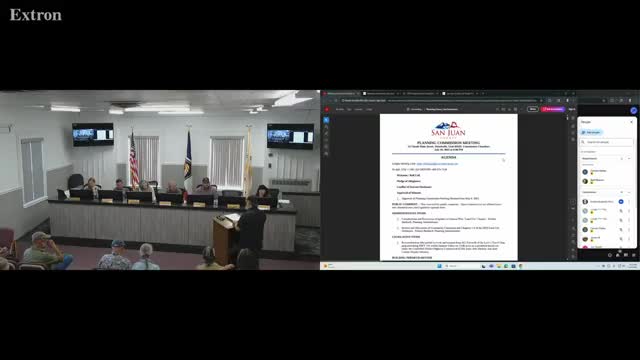
Summary
The San Juan County Planning Commission voted that Love's (the applicant) holds sufficient property interest to be an applicant, but postponed further decisions after extensive public testimony on air quality, noise and neighborhood impacts. The item will return to the commission next month.
The San Juan County Planning Commission on July 8 adopted a finding that Love's Travel Stops & Country Stores (referred to in meeting materials and public filings as Love's or Luvs) has a sufficient contractual property interest to be treated as the applicant for a proposed 13.06-acre travel stop at Sunny Acres, then tabled further action after more than two hours of public comment and commissioner discussion.
The decision to recognize the applicant came after staff and the commission reviewed an administrative-law judge remand directing the commission to make three narrow findings: (1) whether the applicant is a proper applicant; (2) whether the proposed use is a permitted use in the highway-commercial control district; and (3) whether the use is “in harmony” with the surrounding area. The commission adopted the finding on applicant status but did not reach a final determination on the permitted‑use or harmony questions and instead continued the item to the next meeting.
The commission and dozens of residents debated whether a modern travel center or “truck stop” is equivalent to the ordinance term “automobile service station,” a use that appears in the county's 2011 land‑use code. Several residents urged the commission to treat the Love's proposal as a distinct use with larger, different impacts than a conventional service station. Colby Smith, a Northern San Juan County resident who has followed the case for years, said the commission must require specific studies before any approval: “You can ask them to do an air quality study. You can ask them to perform a noise analysis … you could ask them to do a traffic study.”
Neighbors said the proposed site sits adjacent to houses and short‑term rentals and urged stronger buffers or relocation of the facility to a less residential area. Susan Carter, who said she lives about 1,000 feet inside the area residents call the emissions circle, told commissioners she feared “the adverse impact that diesel truck stops have upon the health and safety of communities,” calling out noise, diesel particulates and 24‑hour operations as concerns.
Love's employee Kim Van Dyke answered questions from the commission and the public, saying the company had revised the site plan in response to concerns, moved truck parking away from the north edge of the property and removed underground tanks from the portion closest to residences. Van Dyke said Love's follows federal and industry requirements for fuel systems and emphasized the company provides local jobs and tax revenue. “We take it seriously. That's why we're the largest truck stop in the nation,” she said.
Commissioners and staff repeatedly returned to a narrow legal question: whether the 2011 ordinance language for “automobile service station” reasonably covers a modern travel center that provides fuel, a convenience market, heavier vehicle parking and other services. Planning staff circulated a draft set of findings prepared for the administrative‑law judge's remand and advised the commission that approval could be reached under either of two legal pathways — (a) that the proposal falls within a permitted use in the 2011 code or (b) that the use is nevertheless “in harmony” with the highway commercial district and adjacent uses. The commission adopted the staff recommendation on applicant status but tabled the remaining determinations.
The meeting record shows the commission approved the first finding (that Love's is a proper applicant) during the hearing. Later, after extended public comment and heated exchanges in the audience, the commission voted to table the remainder of the Love's item to the next monthly meeting so members can review additional materials, including new site documents submitted by the applicant and written public comments. Staff also told the commission it has authorization to hire a consultant to assist with coordinating the broader general‑plan and land‑use ordinance updates that are currently underway; commissioners said a consultant will be asked to help clarify definitions and policy questions such as how “truck stops,” “automobile service stations,” and “travel centers” should be treated in the updated code.
What happens next: the Love's application will return to the commission at its next meeting. Commissioners asked staff to include the applicant's latest site plan, any additional technical studies the company offers, and a clear comparison of which elements would be allowed as a permitted automobile service station versus those that, in the view of some residents and legal counsel, require conditional consideration or additional mitigation.
For now, the procedural record includes the planning staff's recommendation and the commission's finding on applicant status; the substantive question of whether the proposal can be approved under the 2011 ordinance or must be considered differently will be decided at a later hearing.