Get Full Government Meeting Transcripts, Videos, & Alerts Forever!
Get email alerts on the Jail Programs Assessment Change topic
No spam. Unsubscribe anytime.
CJCC adopts TCU-5 substance-use assessment; hears jail program and deflection updates
Summary
At a meeting of the Criminal Justice Coordinating Council, members approved replacing the current UNCOPE/ENCODE screening with the TCU-5 assessment on a motion by Mark Helwig and discussed jail population numbers, in-custody programming, and deflection/post-release navigation services.
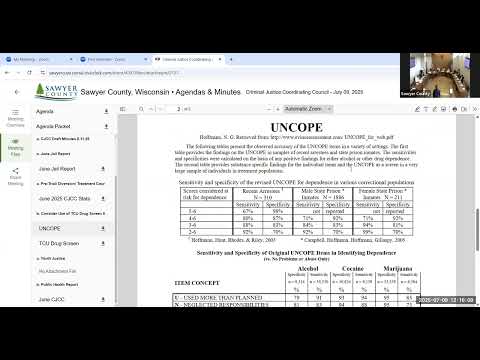
Council members at the Criminal Justice Coordinating Council meeting voted to replace the council’s current substance-use screening tool with the TCU-5 assessment after staff said the Department of Justice recommends the instrument for Treatment and Diversion (TAD) sites. The motion to switch was made by Mark Helwig and seconded by Marshall Savicki; members voted in favor and no opposition was recorded.
The change was presented during the Justice Point report, which also covered jail population and program updates. Justice Point staff reported steady inmate counts “right at about 60,” noted four people on electronic monitoring, and described typical distributions among probation, pre-sentence and sentenced populations as roughly one-third each.
Staff detailed program activity in the facility. GED and foundational classes recorded completions this spring: nine completions for writing foundations and five for math foundations. Other in-jail programming listed included Native American culture and language, Pathways Home, Parenting Inside Out, on-the-job training, Bible study, and AA groups. Staff thanked jail personnel for handling “some complicated situations” recently.
On pretrial and diversion numbers, staff reported 85 active pretrial cases; nine successful pretrial dispositions in the previous month; one unsuccessful; and four people in referral or waiting status due to concurrent custody on other matters. Diversion programs had 11 active participants and nine in referral status, with one successful diversion in June. Treatment court had eight active participants.
Justice Point staff described deflection work in two phases: pre-arrest prevention and post-release navigation. For post-release access, they said the jail lieutenant is setting up a grievance process so inmates can request access to post-release services through navigators. On the prevention side, navigators are working with law enforcement and doing community outreach, distributing prevention kits and staffing community events; staff requested notification of local events where they could set up tables. National Night Out outreach was scheduled for Aug. 5, 5–7 p.m.
Staff also discussed a federal technical-assistance program called Reaching Rural. They emphasized that the county has no grant award yet but that the program offers coaching, technical assistance and grant-writing help; staff said a handout in the meeting packet details available opportunities.
Regarding the assessment change, staff said the council currently uses the UNCOPE (packet included a version labeled ENCODE) and is asking to adopt the TCU-5. A member described the TCU-5 as “much more comprehensive” and said it will be required for programs that move toward medication-assisted treatment (MAT). After brief discussion, the council approved the switch and the presenter closed the Justice Point report.
No formal vote tallies were recorded in the minutes beyond the motion, second and the chair’s announcement that the motion carried.