Lifetime Citizen Portal Access — AI Briefings, Alerts & Unlimited Follows
DNR, Nature Conservancy and Aurora Sustainable Lands outline proposed 18,000‑acre working‑forest easement; committee tables action
Loading...
Summary
Aurora Sustainable Lands, the Wisconsin DNR and The Nature Conservancy presented a proposal to place roughly 18,000 acres of private forestland in Sawyer County under a working‑forest conservation easement and said the DNR intends to pursue federal Forest Legacy funding; committee members asked for more local review and tabled the item.
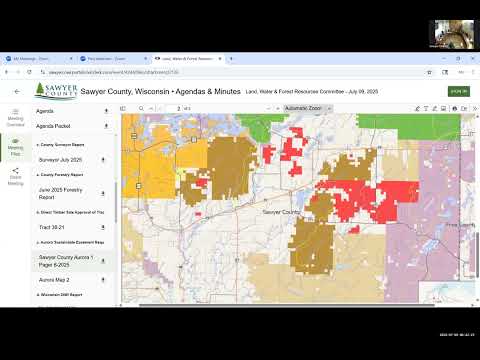
Aurora Sustainable Lands, the Wisconsin Department of Natural Resources and The Nature Conservancy briefed the Sawyer County Land, Water and Forest Resources Committee on a proposed working‑forest conservation easement affecting about 18,000 acres in the county and said the DNR plans to seek federal Forest Legacy funding this fall.
The proposal, presented June 2025, would ask the federal Forest Service for up to 75% of the easement cost through the Forest Legacy Program; DNR staff said a preliminary market analysis could make a federal request “roughly $6,000,000,” which would imply at least a 25% match from other sources if funded.
Committee members said they welcomed information but raised questions about long‑term timber production, public motorized access, gravel extraction, local economic impacts and how participation in carbon markets could change harvest levels. The committee voted to table the request and asked staff and foresters to continue discussions with Aurora and DNR before recommending county support.
The Nature Conservancy’s Matt Dahlman said his organization is assisting with application development and local outreach. DNR forestry program manager Ron Gropp described conservation easements as a tool that keeps land in private ownership, “stays on the tax rolls,” and can preserve public benefits such as designated motorized access roads if negotiated into the easement. Gropp said easements persist if a landowner withdraws from the state Managed Forest Law (MFL) program and that the DNR requires an approved forest management plan for easement lands.
Forrest Gjibo, senior director of portfolio management at Aurora Sustainable Lands, said Aurora is a timber investment company separate from carbon developers and that Aurora currently is actively managing lake‑state properties, including setting up timber sales. Gjibo said Aurora’s approach mixes traditional forest products and carbon market options and disputed portrayal of Aurora as strictly passive landowner: “we are very much, dedicated to traditional forest products,” he said, and noted pending timber contracts in Sawyer County.
Gropp outlined the federal process: the DNR will seek local government engagement, present the application to the Wisconsin Private Forestry Advisory Committee (WIPFAC) for ranking, and, if selected nationally, request a county resolution to accept Knowles‑Nelson stewardship funds as part of the state match. He said WIPFAC typically meets twice a year and includes landowners, academics, USDA and state representatives.
Committee members cited two existing Sawyer County conservation easements — Chippewa Flowage and Lake of the Pines — and asked what local benefits those brought. Gropp said negotiated easement terms previously resulted in designated public motorized access roads (he cited about eight miles on one property and about 16 miles on another) and that easements can require a road‑maintenance endowment.
Members also asked whether a conservation easement would limit gravel extraction; Gropp said such uses are negotiable and that past easements have reserved a small number of gravel sites in limited acreage. Gjibo said Aurora is enrolled in Forest Stewardship Council (FSC) audits and maintains roads to those standards, and that road upkeep and access are among issues Aurora will coordinate on with local stakeholders.
After extended questioning about harvest intensity and carbon revenue, committee member(s) moved to table the item pending further review by county forestry staff and other committees; the motion passed on a voice vote.
The DNR and proponents said local support will strengthen any national application but that federal selection is competitive and not guaranteed. If the project advances, the county would be asked later to pass a resolution allowing Knowles‑Nelson stewardship funds to be used as matching money for an easement purchase.
Remaining questions raised by the committee included: the final market analysis and appraisal once the project advances; the precise funding request and match sources; the easement’s language on motorized access, recreational trails and gravel; and projected long‑term timber harvest levels under Aurora’s management.