
Council members push back on narrative blaming local government for property-tax rises after Senate Bill 1
Get AI-powered insights, summaries, and transcripts
Subscribe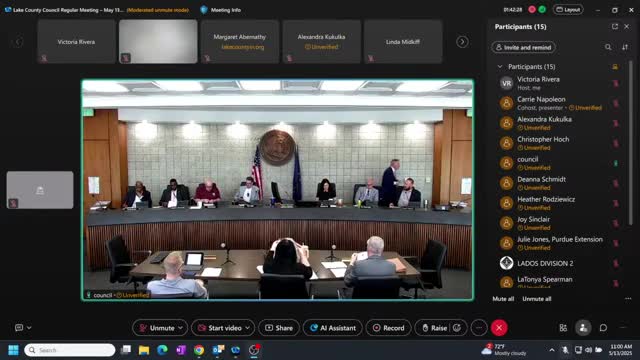
Summary
Multiple council members condemned a narrative that local governments are solely responsible for recent property-tax increases, citing inflation, assessment mechanics and state-level decisions as drivers and vowing to pursue deeper reform work.
Several Lake County Council members used the meeting to dispute a narrative circulating after the passage of Senate Bill 1 that local governments are to blame for steep property-tax increases.
Council members — including long-serving officials and party leaders — said the claim that local units caused 50–60% increases is inaccurate. One member described the narrative as "completely false" and said local levies rose about 22% over five years, and that broader inflation and assessment formulas drove greater tax bills for homeowners.
Speakers emphasized the limits of local authority and asked for clearer public communication. One council member said, "22% doesn't equal 50 to 60% in any math," and blamed federal-level spending that contributed to inflation, alongside flaws in the property-assessment system for commercial properties. Another council member noted Lake County previously operated under a frozen levy, returned tax increments to taxpayers when a TIF district closed on Route 51 and undertook department cuts and layoffs when needed.
Several members called for a more deliberative reform process rather than a rapid statutory change: "If we wanna reform a system, I don't think you do it in a 4-month period. You take several summer study sessions," one council member said, urging lawmakers to examine assessment formulas and the effect of exemptions and thresholds.
Council leaders thanked county staff and local legislators who engaged with the council. One speaker singled out a state senator who voted against Senate Bill 1 and thanked him for that stance. Another council member — who chairs a local party apparatus — said he will work with legislators on a deeper review of assessment and levy policy.
Discussion only: these remarks constituted council comment and direction to pursue further engagement with state legislators and analyses. No formal policy changes or motions were adopted during this discussion.
Clarifying details: the council speakers repeatedly referenced a 22% levy increase over five years as the locally authorized levy change and cited a perceived broader increase in assessed tax bills driven by assessment formulas, inflation beginning about 2020–21, and specific assessment-related laws including a referenced House Bill 1001 and taxing-obsolescence provisions for large industrial taxpayers.