Get Full Government Meeting Transcripts, Videos, & Alerts Forever!
Get email alerts on the Comprehensive Plan Sustainability topic
No spam. Unsubscribe anytime.
Cross Plains committee urges stronger sustainability and flood protections in comprehensive plan update
Summary
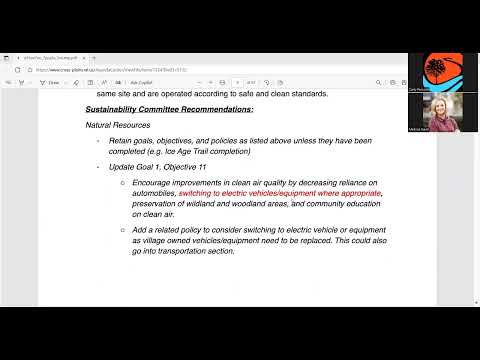
Members of the Village of Cross Plains sustainability committee reviewed draft sections of the village comprehensive plan and recommended that sustainability goals, flood mitigation measures and active-transportation connections be embedded across chapters rather than held in a separate appendix.
Members of the Village of Cross Plains sustainability committee reviewed draft sections of the village comprehensive plan and recommended that sustainability goals, flood mitigation measures and active-transportation connections be embedded across chapters rather than held in a separate appendix.
The committee’s recommendations focused on three priorities: explicitly adding sustainability language to the vision statement and plan chapters; strengthening flood-mitigation objectives and stormwater management practices; and making transportation and trail connections — including regional transit references and local connector trails — clearer in the plan’s policies.
“We may consider recommending…including sustainability goals” said Jenny, Sustainability Committee member, as she walked through proposed edits that would add energy efficiency, conservation, renewable energy and reduced transportation emissions to the draft plan’s survey and visioning materials. Jenny also urged officials to increase emphasis on flood mitigation after severe local flooding during the past decade.
Committee members noted several technical and policy gaps in the draft and recent ordinance language. They discussed the village land division code, Chapter 83, and raised that several earlier water-quality buffer protections — for example, a 150-foot buffer measured from some stream centerlines — appear to have been removed in later code revisions. A commenter who reviewed archived ordinances described finding older protections that were not present in the current redline, and the group flagged the removal as “concerning.”
On stormwater technical limits, committee members repeated a constraint on local authority: state-level rules limit infiltration requirements and the village cannot adopt standards more restrictive than the state. One member summarized the village’s current regulatory ceiling as a 90% post-development infiltration target, and noted developers are typically required to retain and infiltrate most runoff on-site; the Marchstone development presented to plan commission was described in the meeting materials as achieving roughly 96% on some measures. The committee also heard that Phase 1 of the Marchstone project would include roughly 110–115 houses and the overall project would approach several hundred units, described during the meeting as “close to 400.” (Exact figures were discussed as approximate in the meeting materials.)
Agriculture and community food access were another focus. Committee members recommended preserving farmland edges and vegetative buffers along waterways, supporting community-supported agriculture (CSA) drop-off sites and farmers markets, and addressing the current community garden’s vulnerability to flooding and animals. A resident involved with the community garden described persistent standing water after heavy rains and repeated animal damage; garden volunteers have installed temporary plastic fencing that has not been fully effective. The committee discussed whether the garden should be relocated to a more protected site or provided with more robust fencing and support.
Natural-resources concerns included invasive species along stream corridors and PFAS contamination that had prompted a local fish-consumption advisory (one comment recalled a warning advising residents to limit trout consumption to one fish per month). The committee proposed objectives for invasive-species management such as targeted mowing, prescribed burns where appropriate, and guidance for native plantings in streetscapes and park plans.
On transportation, Melissa, Sustainability Committee member, said the transportation chapter already integrates many sustainability objectives the committee supports, including linking Cross Plains to the regional transportation system, improving bicycle and pedestrian connectivity, and protecting rights-of-way for future transit. The draft retains a policy that the village “intends to identify a site for a potential future rail station,” language the committee noted exists in the 2017 comprehensive plan and was simplified in the redline but not fully removed. Committee members asked plan commission to preserve the objective to plan for multi-modal regional connections and to explicitly incorporate a proposed connector trail (referred to in county plans as a Good Neighbor/connector trail) into the village’s implementation priorities.
Committee members and staff said much of the work now is in implementation: the plan contains a range of policies and references to county and regional studies, and the committee’s top recommendation was to ensure sustainability and flood-mitigation actions are carried forward into implementation steps, ordinance drafting and capital projects rather than simply described in the plan text.
Before adjourning, a committee member reminded the group the village should pursue a small “Focus on Energy” grant and keep the option of using matching funds or incentives available during implementation conversations.
The committee did not take formal votes on ordinance changes at this meeting; it reviewed redline drafts prepared by the plan commission and directed staff and the plan commission to ensure the public survey and final draft explicitly address sustainability, floodplain protections and trail connectivity. The meeting closed after a motion to adjourn was made and seconded and carried by voice vote.