Get Full Government Meeting Transcripts, Videos, & Alerts Forever!
Get email alerts on the Emergency Medical Services topic
No spam. Unsubscribe anytime.
Commissioners weigh adding ambulance, city cost-share as Lawrence-Douglas County Fire & Medical budget shrinks
Summary
Douglas County commissioners discussed three LDCFM funding options—gray (included in proposed budget), blue-gray (40‑hour ambulance) and blue (24/7 ambulance linked to Station 6 expansion). Staff and commissioners differed on risk, precedent and timing; staff will provide financial deltas and impacts tied to possible City of Lawrence actions.
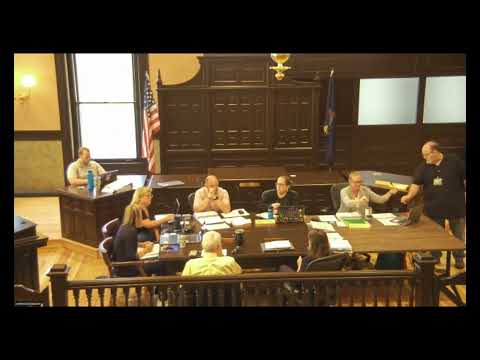
Douglas County commissioners reviewed alternatives for Lawrence-Douglas County Fire & Medical (LDCFM) funding during July 11 budget deliberations, focusing on whether the county should add ambulance capacity now while the City of Lawrence pursues a substantial budget reduction. The commission did not take a vote; staff were asked to provide numerical deltas and analyses for commissioners’ worksheets.
The options shown to the commission were described as: the gray option (the base proposed budget), a blue-gray option that adds a 40‑hour-per-week ambulance, and a blue option that funds a 24/7 ambulance associated with a future Station 6 expansion. Staff placed a “gray” option in the proposed county budget to preserve existing service levels but said it would shift a greater share of shared LDCFM expense onto the county.
Staff numbers and city context Sarah and Jake, county staff who presented the options, told the commission the three alternatives change the county’s operating cost roughly as follows: the gray option is built into the proposed budget, the blue‑gray option adds about $528,000 to the county’s base (a $346,000 delta above the gray option was cited during the meeting), and the blue option adds roughly $1,160,000 (the meeting record shows a county delta of about $1.16 million relative to the base). Sarah also noted the city is facing an estimated $1.5 million reduction in its own fire budget and that restoring cuts or committing to Station 6 will shift large operating and capital obligations between the partners. Sarah summarized the legal timing constraints for levy-setting: “By before the twentieth, we have to notify the county clerk what the maximum mill levy we want to consider for the 2026 budget.”
Why it matters Commissioners framed the discussion as both a public-safety and a partnership issue. Several commissioners said the additional ambulance capacity is needed now; others cautioned against unilaterally changing the county’s share of an agreed governance percentage and warned about setting a precedent that could reduce future cooperation with the City of Lawrence.
Positions, concerns and evidence cited - Some commissioners favored the blue option tied to Station 6, saying longer-run planning and data support additional ambulance capacity. One commissioner said planning now could avoid a larger mill-levy increase later. - Other commissioners urged caution: they cited the existing governance agreement’s percentage splits, the county’s one-year extension of the agreement, and uncertainty about the city’s eventual capital and operating decisions. - Staff noted the city’s capital plan included a Station 6 capital estimate near $3,000,000 and an estimated operating impact of about $4,700,000 for Station 6 over time; those capital commitments would likely be funded by debt on the city side, while operating costs would be an ongoing obligation.
Directions and follow-up Commissioners asked staff to: provide precise deltas for each LDCFM option in commissioners’ worksheets (county incremental costs above the proposed base); model how the county’s cost would change if the City of Lawrence restores part or all of its proposed cut; and clarify operational assumptions tied to Station 6 and accreditation timelines. Staff said they will add the blue/gray/blue‑gray deltas to the comment section of each commissioner’s worksheet and return updated numbers prior to the next deliberation.
No final decision Commissioners did not approve any of the three alternatives during the July 11 session. They discussed the possibility of setting aside one‑time funds, placing conditional commitments in the budget, or using carryover capacity for a temporary ambulance, but expressed concern about committing county funds without clear city commitments. The commission indicated it will continue to consider LDCFM funding as the city finalizes its maximum mill levy and capital plan.