Get Full Government Meeting Transcripts, Videos, & Alerts Forever!
Get email alerts on the Environmental Justice topic
No spam. Unsubscribe anytime.
Chelsea wins All-America City award for resident-led environmental justice work, unveils microgrid plan
Summary
Chelsea, Massachusetts, captured an All-America City Award after presenting resident-centered projects addressing air pollution, extreme heat, park access and an emerging community microgrid that city officials say will power critical facilities during outages.
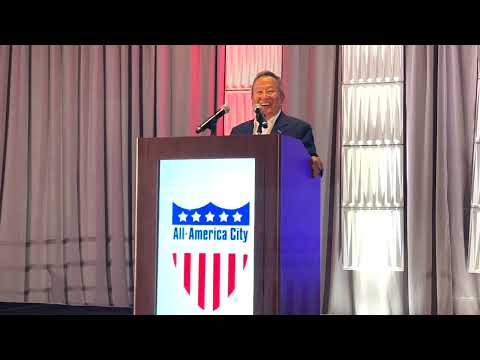
Chelsea, Massachusetts, a densely populated city on Boston Harbor long affected by industry and transportation pollution, was named a 2025 All-America City Award winner on Saturday, marking what presenters and attendees described as the city’s third national recognition.
City and community leaders used their finalist presentation in Denver to highlight a package of resident-driven environmental justice initiatives: a citywide network of air-quality sensors, a Cool Block heat-reduction program and tree-planting campaigns, a new neighborhood park, and plans for a community microgrid to keep critical services operating during outages.
The projects, presenters said, are rooted in neighborhood engagement. “We go out to neighborhoods, to meetings that they’re already attending, and we also frame the issues in a way that resonates with them on a day-to-day basis,” said Judith Garcia, identifying herself as Chelsea’s state representative. Garcia spoke about linking local advocacy to state-level policy work on air monitoring.
City staff described technical and first-phase details for the microgrid. “The first phase, which started under construction, is going to start at city hall, our central police station, and our DPW yard,” said Grace Sigosa of the City of Chelsea. She said a second planned phase would focus on a Chelsea Housing Authority building for seniors and involve two hospitals as partners. Shanica Morales Gonzales of Greenworks added the project is “a community-first project” with feasibility work complete and early community engagement underway.
Lisa Santigate, a Chelsea City Council member, framed the microgrid as an equity effort: “At its core, this microgrid is about climate justice. It’s about putting infrastructure in service of people, not just keeping the lights on,” she said.
Speakers described the city’s air-sensor network as a tool for residents and advocates to document pollution spikes and press for safer truck routing and other protections. “We have installed a network of air-quality sensors across the city so that we can track where pollution is worst, and when it’s most dangerous,” said a youth speaker participating in the presentation.
Chelsea presentation participants credited community-based partner GreenRoots and other nonprofits with helping reach predominantly Spanish-speaking residents. Officials said engagement tactics include door-to-door outreach, embedding meetings in existing community gatherings and framing technical issues around everyday concerns such as bus-stop shade and household energy bills.
Presenters also showed smaller, on-the-ground outcomes: sidewalk repaving using lower-heat concrete, a previously vacant lot converted to a community park with a planned splash pad, and expansion of a TreeKeeper program. Attendees on the Chelsea delegation described the visit to Denver as strengthening local partnerships and boosting morale back home.
Chelsea’s delegation included elected officials, school and nonprofit staff, youth delegates and city managers who said the award recognizes long-term community organizing and public-private partnerships rather than a single project. Onstage reaction after the win included celebratory remarks from multiple delegation members and organizers.
The Chelsea presentation emphasized community control and resident ownership of assets in future phases of the microgrid, and officials framed the effort as potentially creating local jobs and returning economic benefits to the community if the model evolves toward locally owned utility assets.
Speakers acknowledged challenges remain: air pollution stems from regional freight, nearby Logan Airport fuel storage and major roadways; energy projects require utility cooperation, grant funding and technical capacity. City officials said the microgrid’s expansion and long-term ownership model will depend on those partnerships and additional funding.
Chelsea’s appearance in Denver combined technical proposals with personal stories and local leadership examples, and the All-America City recognition on Saturday concluded a multi-day finalist process in which the city presented projects developed with neighborhood partners and youth participants.