
County Supervisors Association briefs board on 2025 legislative session and data work
Get AI-powered insights, summaries, and transcripts
Subscribe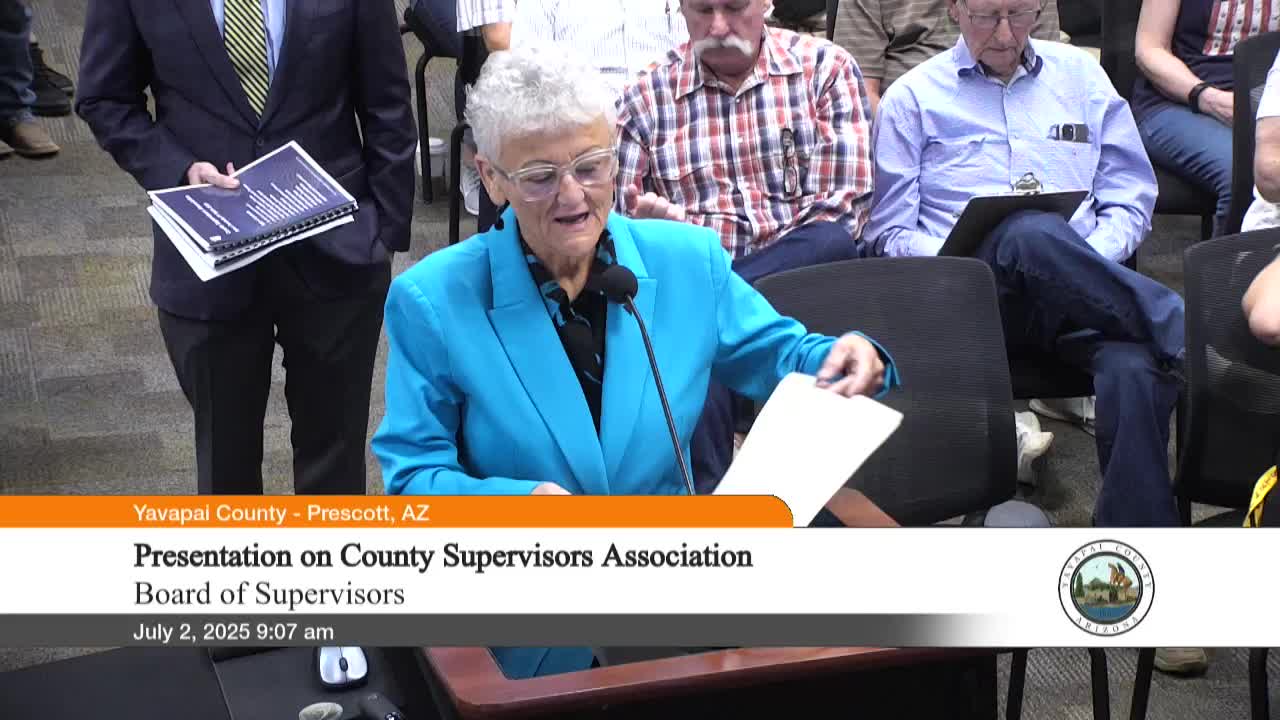
Summary
The County Supervisors Association (CSA) presented a roundup of the recent legislative session, one‑time budget allocations affecting counties, and CSA’s research and data‑visualization programs. CSA staff highlighted ongoing issues including probation funding, long‑term care (ALTCS) assessments, and accessory dwelling unit statute changes.
The Yavapai County Board of Supervisors received a presentation July 2 from Craig Sullivan of the County Supervisors Association (CSA) and CSA President Lynn Pankrazi (Yuma County) summarizing CSA activities, research initiatives and this year’s state legislative outcomes.
Sullivan told the board CSA is expanding data‑analytic work and said the association won a $1.4 million grant from ABOR to fund research partnerships with universities. He described CSA’s role in tracking hundreds of bills each session and working through the legislative policy committee to protect county interests.
On policy outcomes, CSA staff and supervisors highlighted several items that will affect counties next fiscal year: probation funding was addressed with one‑time federal money to bridge a shortfall but no ongoing funding for salary increases; the state raised contribution rates for the Department of Corrections retirement system and included an offset appropriation for counties; and the Arizona Long Term Care System (ALTCS) allocation that affects property tax pressure showed a multi‑county change that CSA will monitor. Sullivan also noted statutory updates to accessory dwelling unit rules and enhanced audit provisions for county treasurers in response to a Santa Cruz County criminal case.
Supervisors asked for continued CSA help on hiring and technical changes — for example, modifications to sanitarian requirements that CSA worked to pass — and thanked CSA staff for weekly legislative policy work during session. Sullivan said CSA will send Yavapai County a complete summary of bills and a longer report for management staff to implement legal changes by the general effective date.
The board thanked CSA leadership and noted CSA’s October legislative summit in Yuma, where counties set their legislative priorities for the next session.