Get AI Briefings, Transcripts & Alerts on Local & National Government Meetings — Forever.
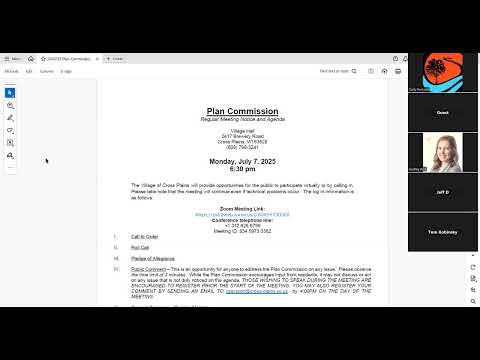
Cross Plains plan commission postpones Marchstone preliminary plat after residents raise flooding, traffic and pesticide concerns
Loading...
Summary
The Village of Cross Plains Plan Commission on July 7 postponed consideration of the preliminary plat for the Marchstone (Ingenuity) subdivision after a public hearing in which residents and watershed groups raised detailed concerns about stormwater, traffic, school impact and pesticide runoff.
The Village of Cross Plains Plan Commission on July 7 postponed consideration of the preliminary plat for the Marchstone (also described in materials as the Ingenuity property) after a lengthy public hearing and staff review that drew more than a dozen in‑person and online speakers and detailed technical questions from commissioners and village staff.
Residents and conservation groups urged the commission to delay approval until the village receives more analysis and stronger guarantees on stormwater, groundwater recharge and traffic access. Many speakers also objected to a proposed golf course inside the 483‑acre project, saying it risks runoff of pesticides and fertilizers into Black Earth Creek, which local groups and the Department of Natural Resources classify as an outstanding resource water and a class 1 trout fishery.
"Golf courses are notorious for causing large amounts of herbicide and pesticides into water sources," said resident Jocelyn Wilkie, who asked how the development would protect the village water supply. Tyler Marshall, a resident who identified recent local rainfall records, told the commission: "Converting 483 acres of farmland into roofs, streets, parking lots, and a golf course will replace our best natural sponge with hard surfaces, sending runoff more quickly into the Black Earth and Brewery Creeks and raising flood peaks for everyone downstream."
Why it matters: The preliminary plat would enable the developer to begin construction of the first phase of MarcheStone—about 130 housing units in phase 1 by the developer's count—and dedicates a large outlot for a public golf course. Commissioners and staff said the scope of the project and the watershed's protected status require more detailed hydrologic and infrastructure assurances before the commission can recommend final approval to the village board.
Public concerns and technical questions
Speakers pressed three main areas: stormwater/flood risk, traffic and school/municipal services.
Stormwater and water quality: Several commenters asked the village to require watershed‑scale modeling that includes rainfall volumes equal to or larger than Cross Plains’ 2018 historic event (about 15 inches in 24 hours, as cited by a resident). The Black Earth Creek Watershed Association and the Southern Wisconsin chapter of Trout Unlimited urged explicit, independent professional assurances that recharge areas and springs feeding Black Earth Creek would not be impaired. "If the spring is compromised or degraded or its capacity diminished, the creek will suffer," read a letter presented to the commission.
Traffic and circulation: Speakers from neighborhoods near Glacier Creek Middle School and Airport Road said existing congestion at school peak hours would worsen. Several residents asked that the developer provide or guarantee a Highway 14 connection rather than routing much added traffic onto Airport Road and Church Street near the school. A number of commenters recommended considering traffic signals, not just a roundabout, and asked for a more extensive traffic study that measures traffic at village limits rather than a single short study period.
Schools and emergency services: Wiser Engineering’s student‑generation estimate, included in the commission packet, was questioned. Staff materials note Wiser estimated roughly 80 additional school‑age children from phase 1 (using student generation rates of 0.5 to 0.7 for ~130 units); several residents said real‑world experience and demographic expectations suggested a higher number. Audrey Rice connected the land‑use decision to EMS capacity, asking how the village will ensure emergency response can scale if the district membership or mutual‑aid arrangements change.
Pesticides and public health: Several speakers pointed to recent studies linking residence near golf courses to higher odds of Parkinson’s disease and asked for restrictions on pesticide and fertilizer use or binding homeowner standards. "If we as a community are serious about fighting climate change, reducing water usage, and protecting Black Earth Creek, we should not build a golf course," said Kelly Unger.
Developer and staff responses
Jeff Hain, who introduced himself as the developer (with his son, Kyle), told the commission the developer will pay for infrastructure required by the village and meet village ordinance standards. "We will pay for everything that affects our development—our fair share of water tower, sewer and water, sidewalks, roads," Hain said. He also described efforts to maximize infiltration and said the team has experience operating other golf courses and complying with state rules.
Hain said the project will aim for very high infiltration rates—staff and consultants described site infiltration targets ranging from the developer’s 90–96% goals up to a design effort to approach 100%—and that changes to the plat already removed 10 lots to accommodate stormwater requirements. Hain also described public uses of course‑related amenities, saying a large public putting green would be "free of charge" and could be credited toward park dedication discussions; he said no private pool amenity will be built as part of the subdivision.
Village staff and the village engineer (Brian) told the commission they need more detail about stormwater modeling, pipe sizing and whether additional parallel water mains would be required to serve properties north of the plat. Brian noted that if a second parallel water main benefits properties outside the plat it could be a village expense, not entirely a developer cost, and recommended preserving rights‑of‑way for future connections as part of the preliminary review.
Commission action and next steps
After public comment, commissioners debated whether additional technical reviews and interagency coordination (including water‑tower and sewer planning) should be completed before the plan commission forwards a recommendation to the village board. The commission voted unanimously to postpone consideration of the plat to a future plan commission meeting (the item was continued to the commission's next meeting in August unless an earlier special meeting is scheduled).
The developer said the delay may push grading and tree clearing into next year; staff and the developer also agreed to organize smaller, technical meetings in the coming weeks to respond to staff and commission questions about stormwater design, road cross sections, the sewer/water plan and parkland/amenity credits.
The commission did not approve zoning changes or a final plat at the meeting; commissioners and staff said zoning and any requested setback flexibility will require separate review and formal zoning actions.
Ending: The Marchstone preliminary plat remains under review. The plan commission set no final approval and directed staff, the developer, and village consultants to return with more technical detail and drafted mitigation commitments before the commission resumes consideration.