Get Full Government Meeting Transcripts, Videos, & Alerts Forever!
Get email alerts on the Economic Development topic
No spam. Unsubscribe anytime.
Montgomery County sees early-2025 rise in unemployment claims as officials press to expand advanced-manufacturing space
Summary
County economic indicators for Q1 2025 presented to the Montgomery County Economic Development Committee showed a spike in unemployment insurance claims tied to federal layoffs, continuing office vacancy trends and an urgent need for larger industrial/flex spaces to grow life‑science and satellite/advanced communications manufacturing.
Montgomery County officials and economic development staff on the county’s Economic Development Committee heard a quarterly indicators briefing for Q1 2025 showing a notable increase in unemployment insurance claims linked to recent federal layoffs and a countywide shortage of modern industrial and flex space that could limit local manufacturing growth.
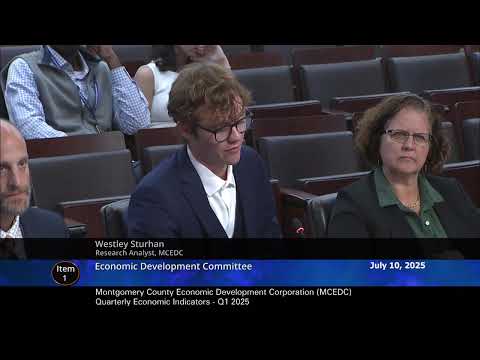
The Q1 briefing, delivered by Wesley Serhant, research analyst at the Montgomery County Economic Development Corporation, said the county was seeing what he described as “the water before impact” — an early signal of labor-market changes that preceded broader effects from large federal layoffs. “For the unemployment rate compared to the rest of the nation we’re actually still doing pretty well. We’re a full percentage point under the national unemployment rate,” Serhant said, noting that initial claims and continuing claims were elevated in the Washington, D.C., area compared with the same period last year.
Committee members pressed staff for more precise residence-versus-workplace data after staff noted that unemployment-claims totals are recorded by where people work, not where they live. Ben Craft of Montgomery County Planning said staff compared the first 25 weeks of 2024 with the first 25 weeks of 2025 and found that Washington, D.C., initial and continuing claims were “about double” the magnitude of the prior year’s period, a pattern that likely affects Montgomery County because many residents work in D.C.
Staff highlighted several headline datapoints. The presentation identified roughly 2,200 layoffs linked to the Department of Health and Human Services and about 1,400 contractor layoffs tied to USAID among large federal actions contributing to early-2025 claim totals. County staff also reported office-vacancy increases, rising median home prices, a small rise in unemployment, and a unique local venture-capital pattern: a large add-on to an existing X Energy deal accounted for most of the county’s Q1 venture-capital total.
X Energy, described in the briefing as a nuclear-energy company, received an additional $182,000,000 in investment that made up the bulk of Q1 venture-capital inflows; staff said X Energy leased roughly 25,000 square feet of office space in the county and that a larger announcement was forthcoming.
The committee spent substantial time on land use and industrial capacity. County staff reported the county has about 1,200 acres of zoning that can accommodate manufacturing, with a higher employment density in employment and commercial‑residential zones than in industrial zones. Staff estimated nearly 10,000 manufacturing employees across more than 400 establishments, generating about $1.2 billion in annual wages — approximately $126,000 per employee on average (staff noted the figure is influenced by including R&D and life‑science employment in the classification).
Speakers repeatedly warned that available buildings and parcel sizes outside targeted areas are often too small or old to host modern advanced‑manufacturing operations. “We don’t have a lot of manufacturing space,” said Laurie, a Montgomery County Economic Development Corporation official, who added that larger, secure parcels and newer single‑story “flex” buildings are what many advanced manufacturers seek.
Staff highlighted geographic concentrations: the county’s life‑science center and the Germantown‑Clarksburg corridor contain a disproportionate share of newer, larger flex buildings and advanced‑manufacturing employment. The briefing listed major local firms in the satellite and advanced communications cluster, including Hughes Network Systems, RADA Technologies, DRS, Wabtec and others; staff said that cluster employs roughly 2,500 people at the largest firms and shows a location quotient near 10, indicating a much higher local concentration than the national average.
Presenters compared parcel and building metrics: in Germantown/Clarksburg and the life‑science area, the typical industrial/flex parcel averaged about 7.5 acres and 70,000 square feet, versus roughly 3.75 acres and 30,000 square feet in the rest of the county. Staff also reported that a majority of the county’s industrial/flex buildings were built before 1980 and that construction of such buildings declined markedly after 2010.
Committee members and staff discussed potential responses. Montgomery County Economic Development Corporation staff said they are urging planners to preserve large commercial parcels such as the COMSAT site so the county can accommodate large life‑science or manufacturing campuses. The committee also discussed developer outreach and examples of private-sector spec buildings: staff credited a recently completed tilt‑up spec facility at 700 Progress Way in Gaithersburg with landing AstraZeneca’s biomanufacturing site.
Workforce alignment was raised as a priority. Council member Glass and others asked how county education and training providers — Montgomery County Public Schools, Montgomery College and WorkSource Montgomery — are being integrated into efforts to connect students and workers to growing advanced‑manufacturing employers. Staff said Montgomery College already operates biomanufacturing technician programs tied to local employers and that WorkSource Montgomery coordinates apprenticeships and talent pipelines with colleges and K‑12 partners.
No formal votes or policy decisions were taken; staff said the Germantown and Clarksburg master‑plan updates, plus other county planning efforts, will examine where to accommodate manufacturing‑suitable land and new flex buildings. Ben Craft asked for follow‑up data-sharing on the residence versus workplace distribution of unemployment claims so the county can better understand which residents are affected.
County staff recommended ongoing monitoring of federal‑layoff impacts, continued outreach to developers about building new spec flex space, and coordination with education and workforce partners to align training with employer needs. Officials also signaled an imminent larger announcement related to X Energy’s local activity.
The committee said it will continue the conversation as master plans progress and as staff collect more data on layoffs, permits, and land availability.