Get Full Government Meeting Transcripts, Videos, & Alerts Forever!
Get email alerts on the Urban Forestry topic
No spam. Unsubscribe anytime.
Advisory committee discusses model ordinances to protect large trees; agrees to continue item and coordinate with Urban Forestry Tree Commission
Summary
Members reviewed examples from other cities, discussed thresholds and enforcement challenges, and voted to keep tree protection on future agendas and coordinate with Worcester's Urban Forestry Tree Commission.
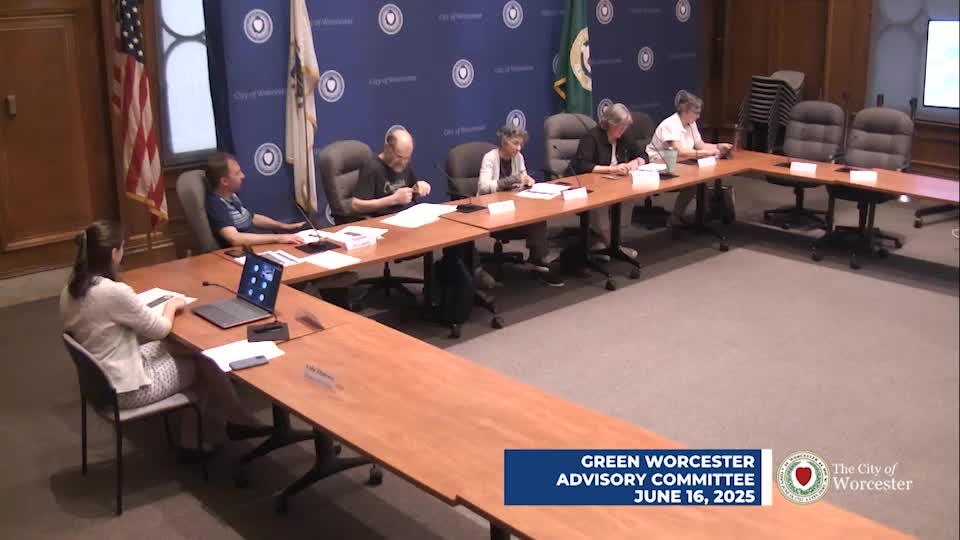
The Green Worcester Advisory Committee discussed June 16 what it would take to preserve large existing trees within Worcester, reviewing municipal examples and voting to carry the item forward for additional research and coordination with the Urban Forestry Tree Commission.
Ted Connor, who raised the item, summarized ordinances and regulations from multiple municipalities — including Providence; Cambridge; Somerville; Springfield, Mass.; and Sacramento, Calif. — that use diameter‑at‑breast‑height (DBH) thresholds and municipal fees or replacement tree requirements for removal of significant or exceptional trees. Connor noted examples in other cities where fines or a city tree fund finance replacement plantings and where thresholds and exemptions vary by jurisdiction.
Committee members emphasized enforcement, exemptions for risky or hazardous trees, and the need to coordinate closely with the Urban Forestry Tree Commission and city departments. AJ Elton, introduced in the discussion as a community forester with past experience in Providence and the Green Infrastructure Center, was cited by members as a resource on implementation and enforcement challenges.
Evelyn Hurwitz and other members urged collaboration with the Urban Forestry Tree Commission and the new urban forestry master plan, which committee members said already includes action items to consider how development accounts for trees. Members discussed precedents such as ordinances that treat native species differently, thresholds used to define “significant” or “exceptional” trees, and replacement ratios (for example, planting multiple small trees for the loss of a large DBH specimen).
Committee action: At the meeting the committee moved and approved a motion to keep the tree‑preservation discussion on the committee’s agenda as continued business so members can research ordinance language, enforcement mechanisms and coordination with the Urban Forestry Tree Commission. Committee chair Mary Nittle called for the motion; Ted Connor moved it and Evelyn Hurwitz seconded. There were no recorded objections and the motion passed.
Ending
Members said they will continue research on model ordinances, enforcement language and exemption procedures and will coordinate next steps with the Urban Forestry Tree Commission and city staff.