Get Full Government Meeting Transcripts, Videos, & Alerts Forever!
Get email alerts on the Restoration Wetlands topic
No spam. Unsubscribe anytime.
City, Mass Audubon and consultants outline Broadmeadow Brook restoration to reduce flooding and restore habitat
Summary
Division of Ecological Restoration and consultants presented conceptual designs to reopen a decommissioned sewer causeway, remove invasive phragmites and add green infrastructure to slow stormwater and improve habitat at Broadmeadow Brook Wildlife Sanctuary.
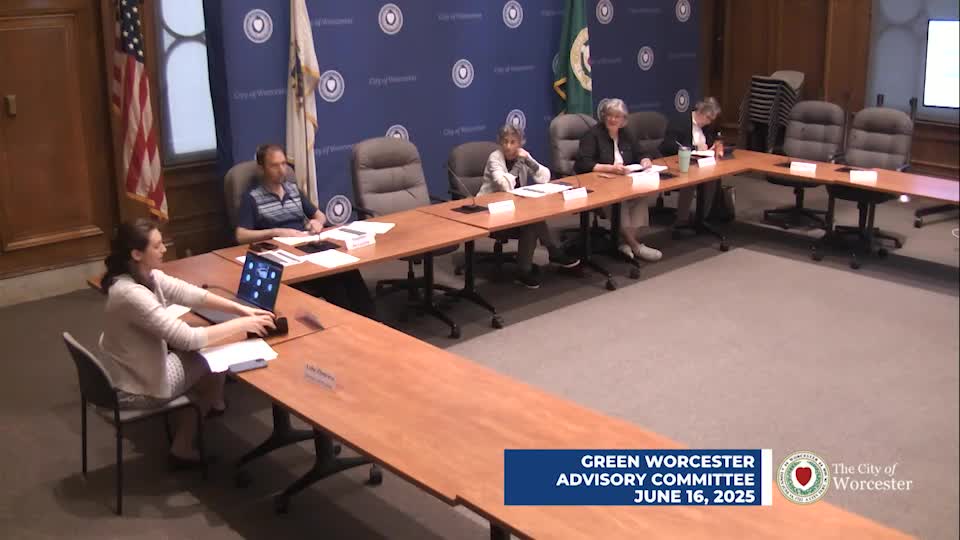
Kate Benson, a project lead with the Massachusetts Division of Ecological Restoration, and Alex Simpson of engineering firm Weston & Sampson presented conceptual designs June 16 to the Green Worcester Advisory Committee for restoring Broadmeadow Brook and the adjacent Broadmeadow Brook Wildlife Sanctuary.
The proposal centers on removing sections of an elevated earthen berm that was built to carry a sewer force main and has constrained the brook into a straightened channel. The city decommissioned the force main in 2020; presenters said the berm and former causeway now prevent the brook from accessing its natural floodplain and limit the wetland's ability to store floodwater, settle sediment and process nutrients.
Restoration proponents said the site is a roughly 40-acre wetland complex with about 20 acres dominated by dense stands of invasive phragmites, which they said reduce habitat value and flood-storage capacity. Benson said the project team envisions removing or lowering parts of the berm so the stream can meander across its floodplain, increasing residence time for stormwater and improving water quality downstream. She also described community-access improvements such as new boardwalks and viewing platforms so neighbors can safely use the sanctuary.
Simpson described watershed modeling and a screening of green‑infrastructure opportunities. He said the project team screened the catchment, identified about 42 potential green‑infrastructure locations across the watershed and prioritized clustered sites where interventions would gain scale economies. He showed concepts for school grounds (Rice Square school) that would replace impervious surfaces with porous paving, plantings and a floodable field to reduce runoff, provide shade and outdoor learning space.
Presenters said the brook is affected by flashy flows from an upstream watershed that is roughly 40% impervious and that a downstream 600-foot buried culvert currently limits riparian interaction. They noted historic leaks from the once-oversized force main in 2011 and 2015 and said the Dunkirk Avenue pump station and the Route 20 sewer reconfiguration reduced the need for the old main prior to its decommissioning.
Committee members asked about project sequencing, monitoring and funding. Benson said the team has preliminary conceptual designs and plans to collect additional site data (subsurface conditions, groundwater monitoring, permitting-level analyses) before proceeding to permitting. She said the project will be multi‑year and likely phased; the team is engaging the Conservation Commission and expects state and local permits will be required.
On invasive phragmites, presenters said removal will be multi‑year and require repeated cutting, herbicide treatment and extraction of rhizome mats so the root mass no longer elevates the plant above the wetland surface. The presenters said monitoring will include water‑quality sampling (noting the Blackstone River Coalition already monitors water quality at the sanctuary) and ecological tracking to record flood‑storage and habitat changes.
Benson and Simpson credited Mass Audubon, the City of Worcester (including Dave Harris and Sewer Operations) and consultants (Princeton Hydro, Weston & Sampson) as project partners. They said the team has held listening sessions with neighbors and youth groups and will continue community engagement as designs advance. The team said they will pursue funding and aim to complete permitting‑level plans over the coming year, then move toward permitting and phased construction when funds become available.
The committee requested future updates; presenters said they would return with progress reports and that staff contact information was available.
Ending
Presenters described the project as an effort to return the sanctuary toward a “dynamic, diverse and self‑sustaining” stream and wetland system while improving recreational access. Benson said the team will continue community engagement, pursue funding and work through permitting and multi‑year, phased construction.