Get Full Government Meeting Transcripts, Videos, & Alerts Forever!
Get email alerts on the Strategic Plan topic
No spam. Unsubscribe anytime.
Worcester trust fund adopts strategic plan with target to prioritize deeply affordable units, adds predevelopment pathway
Summary
The Worcester Municipal Affordable Housing Trust Fund Board of Trustees on June 11 adopted a revised five‑year strategic plan that directs the board to aim to allocate about 35% of its five‑year funding to deeply affordable units and creates a single RFP with a formal predevelopment pathway and scoring priorities for emerging and underrepresented developers.
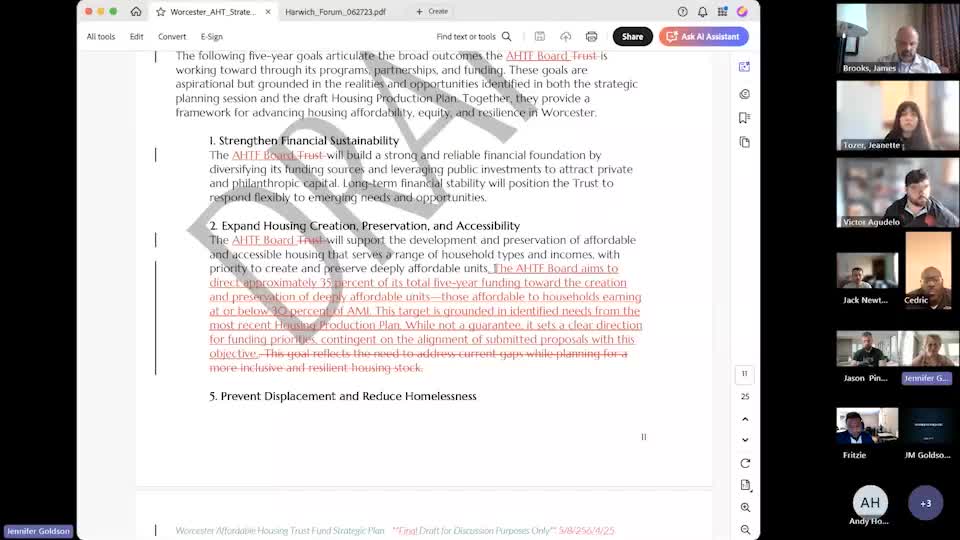
The Worcester Municipal Affordable Housing Trust Fund Board of Trustees on June 11 adopted a revised five‑year strategic plan that, among other changes, directs the board to aim to allocate approximately 35% of its total five‑year funding to deeply affordable units — defined in the plan as units affordable to households at or below 30% of area median income (AMI).
The plan, presented remotely by consultant Jen Golston, also narrows the application process to a single request for proposals (RFP) that will include tracks for predevelopment, construction, rehabilitation and conversion projects and establishes a scoring framework that will prioritize projects that create or preserve deeply affordable units and favor emerging and historically underrepresented developers.
Golston said the target is aspirational and not a year‑by‑year mandate: “the board aims to direct approximately 35% of its total 5‑year funding,” she said, adding the language was written to preserve flexibility because the Trust cannot control what proposals are submitted. The text grounds the target in the city’s most recent housing production plan and clarifies the target is contingent on alignment of applications with the objective.
The plan adds a formal predevelopment pathway in year 1, describing predevelopment as site surveys, title research, environmental assessments, market studies, preliminary architecture and engineering, permitting expenses and similar activities. The plan proposes structuring predevelopment support as “low‑risk recoverable advances (for example, loans repaid from project financing)” and instructs staff and the board to explore project caps per development and methods to secure repayment (for example liens or developer contribution/skin in the game).
The single RFP is expected to contain up to three funding rounds: a likely larger fall round that would use CPA (Community Preservation Act) funds if available, and contingent rounds two and three dependent on securing additional funding or unspent allocations from earlier rounds. The plan formalizes a competitive scoring process tied to the strategic goals, establishes that applicants judged strong but unfunded may be invited to reapply in the same fiscal year if funds become available, and sets a one‑year cooling‑off period for proposals denied as noncompetitive.
The board also directed that the Trust consider retaining a consultant to provide technical assistance focused on emerging and small‑scale developers — including affirmative fair housing marketing, underwriting best practices, and an independent reviewer for application/performance materials — while clarifying which applicant support functions remain the responsibility of city staff.
Trustees voted to adopt the plan as amended (motion made and seconded; roll‑call vote recorded as unanimous). The plan will be updated in an RFP if Community Preservation Committee awards are confirmed later this month, staff said.
The board also asked staff to develop a more comprehensive onboarding packet for trustees and to explore a modest training budget for board development.
Staff noted next steps: finalize the RFP language to reflect the plan, develop predevelopment caps and security mechanisms in year 1, and return with scoring criteria tied to the strategic goals for board approval.