
Worcester committee approves first-round Community Preservation grants, sets reporting and clawback conditions
Get AI-powered insights, summaries, and transcripts
Subscribe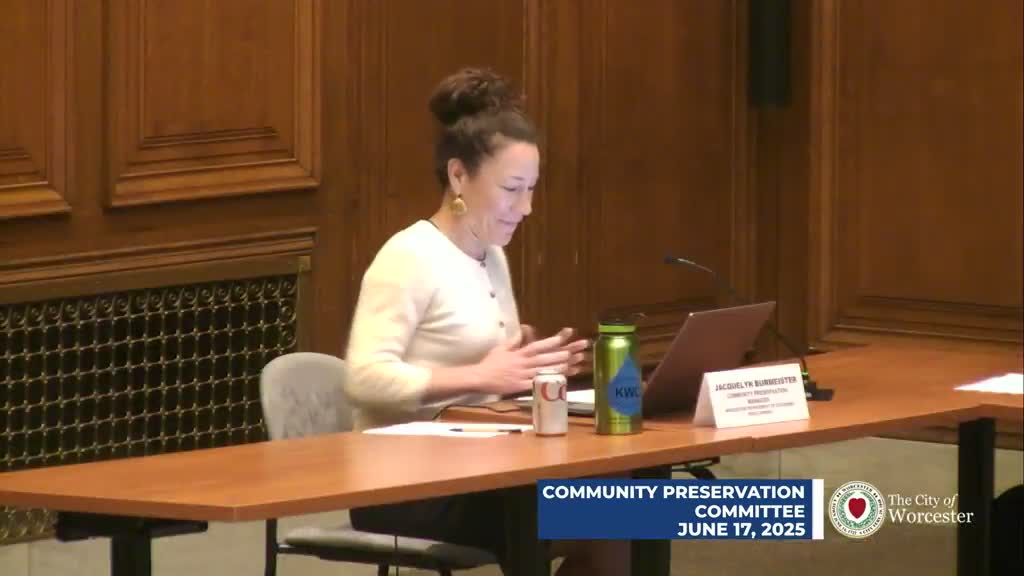
Summary
On June 17 the Worcester City Community Preservation Committee approved a slate of first-round grant recommendations and attached quarterly reporting, signage and six‑month clawback conditions; recommendations move next to City Council for final approval.
The Worcester City Community Preservation Committee on June 17 approved a first round of grant recommendations, allocating $2,064,515.50 for historic‑preservation, open‑space and community projects and attaching reporting and clawback conditions before the slate moves to City Council for final approval.
The committee — using a scoring rubric in the Community Preservation Plan that rates projects on seven criteria with a maximum score of 43 — approved the recommendations after a series of motions and voice votes. Jacqueline, a CPC staff member, told the committee the rubric groups projects by color: projects scoring 33 points or higher are “blue,” 28–33 are “green,” 22–28 are “yellow,” and below 22 fall into a lower band. The committee also confirmed with city finance staff that, although the pilot was advertised at $4,000,000, the city can spend up to $4,500,000 for this round.
Why it matters: This was the committee’s first pilot funding round under the Community Preservation program. The group set conditions it said were intended to protect taxpayers and ensure projects proceed: quarterly project updates, signage acknowledging CPC funding, and a process to claw back funds if projects do not progress. Committee members and staff also flagged that all awards will be reimbursement‑based and require a signed grant agreement before invoices can be paid.
Most important facts: The committee approved a grouped package of projects (including multiple historic‑preservation and park projects) by motion and voice vote. The motion to approve the primary slate was made by Eric Stratton (parks representative) and seconded by Diane Long (Historical Commission); the motion passed on an “aye” voice vote. Committee members also voted separately to fund the Cook’s Pond Dam project at $53,000 and the Darista Goldsberry dedication area and east side trailhead at $50,006.78. Members approved a partial, $70,000 allocation to the City Clerk’s archival preservation request and discussed but deferred a request from the Ecotarium pending additional conservation‑restriction language.
Conditions and timeline: Committee members attached three standard conditions to the awards: (1) project status updates every three months, with the committee to revisit the reporting requirement after 12 months; (2) signage or other public acknowledgement that the project was funded by the CPC; and (3) a clawback provision to be written into grant agreements that allows the city to rescind funds for projects delayed more than six months after execution of the grant agreement. Committee members discussed an additional idea — recapturing funds if a property is sold within a longer period (one member suggested 10 years) — and asked staff to draft appropriate language into the grant templates where practicable. Committee members agreed to exclude the Affordable Housing Trust Fund award from some of the clawback/reporting stipulations because that program has its own existing processes.
Reimbursement and contracting: Jacqueline and Paul Marano of the city explained the awards are reimbursement‑based. As Jacqueline told the committee, “All of these funds are reimbursement based, and we cannot make a reimbursement if the invoice is for before the grant agreement was developed.” City staff said they will draft grant‑agreement templates and begin negotiations with recommended applicants; because the templates are still being finalized and roughly 20 separate agreements must be written, staff warned the reimbursement process may be slower than applicants expect. Staff said they will prepare the memo and packet for the July 15 City Council meeting, the next step for final approval.
Discussion highlights and unresolved items: Committee members pressed for clarity on how match funds were counted (one member noted differences in how the housing trust counts match), and several members said they preferred partial funding or phased funding for large proposals. The committee asked staff to provide constructive feedback to applicants that were not funded so they can improve future submissions. The Ecotarium’s request remained open; staff confirmed a recreational‑use restriction could be applied to part of a property and that funding could be conditioned on placing such a restriction.
Next steps: Staff will prepare a narrative memo and the grant‑agreement drafts for City Council. If Council rejects any recommendations, the committee will decide whether to reallocate returned funds or hold them for the next round. Committee members discussed meeting again in late summer or fall and directed staff to return sample signage language for use in grant agreements.
Ending: The committee characterized the meeting as a successful pilot round and urged timely follow‑up with applicants, noting that reimbursements cannot begin until after a signed grant agreement and that staff will report back on negotiation progress and any projects that decline to execute agreements.