
Worcester Housing Authority outlines multi-site accessibility upgrades, adds dozens of accessible units
Get AI-powered insights, summaries, and transcripts
Subscribe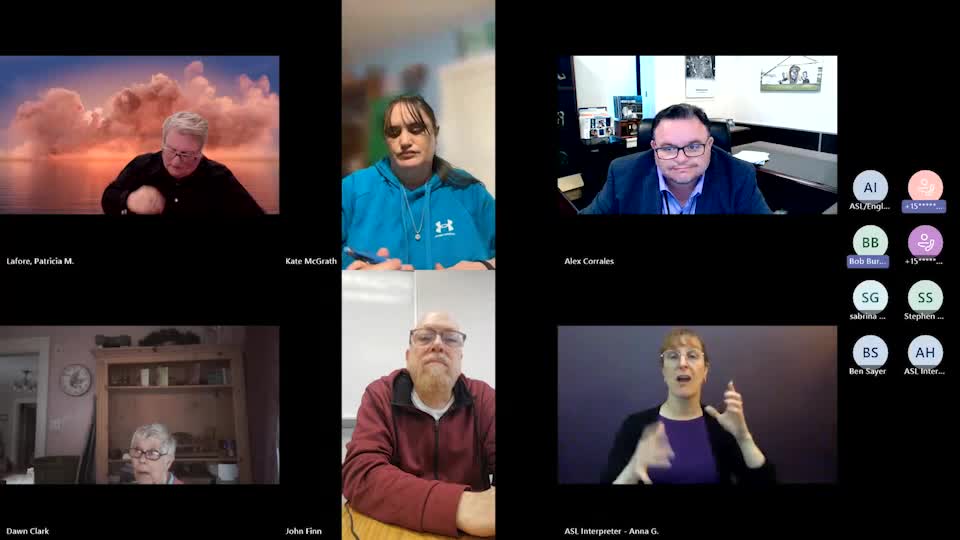
Summary
Worcester Housing Authority Executive Director Alex Corrales told the Accessibility Advisory Commission the authority plans to increase wheelchair-accessible units across several developments, invest roughly $4.17 million in accessibility (MAAB) upgrades and pursue larger redevelopment projects contingent on federal and state funding.
Worcester Housing Authority Executive Director Alex Corrales told the Accessibility Advisory Commission on June 17 that the authority is expanding the number of wheelchair-accessible units across multiple sites and committing millions for building upgrades.
Corrales said the authority will raise accessible-unit totals through ongoing redevelopment and modernization work that spans Curtis Apartments, Lakeside Apartments, Booth Apartments and other sites. "But I'm happy to report that the building is full, that, the majority of the residents that live there are taking advantage of the wraparound services that we offer in the building," Corrales said about 38 Louis Street, one of the authority's recently completed projects.
The authority expects to finish phase one of Curtis Apartments this calendar year, adding units and moving relocated residents back into new buildings. Curtis currently has 372 units, of which 11 are wheelchair accessible; the authority plans after all phases to have about 527 units and roughly 52–53 wheelchair-accessible units, Corrales said. At Lakeside Apartments—built in 1949 and currently 202 units—the authority plans to demolish and replace buildings to reach about 350 units, including 35 accessible units; demolition of an initial chunk of about 48 units is expected in late summer, with a first phase of 116 new units to follow.
Corrales also described Booth Apartments, a 44-unit property on roughly 7 acres that the authority views as an opportunity to build between 100 and 200 new units, and a longer-term master plan for the sprawling Great Brook Valley site (roughly 530 apartments across about 60 acres). He said the authority will go before its board to request a consultant for a master plan for Great Brook Valley.
On accessibility upgrades tied to the Massachusetts Architectural Access Board (MAAB) work, Corrales said the Housing Authority committed more than $4,170,000 in its HUD five-year plan for improvements at six sites. He listed site-specific investments mentioned in the presentation: 275 Pleasant Street (about $745,000 for lobby doors, automated openers, common-area bathrooms and signage); 40 Belmont Street (about $260,000); 425 Pleasant Street (more than $1,000,000 for sidewalks, regrading, passenger loading and unit bathtub access); and 30 Wellington Street (about $1,800,000, including converting six existing units to full accessibility). Corrales credited outside partners, including the Center for Living and Working, for technical support on conversions and accessibility planning.
Corrales described services tied to newer supportive-housing developments: on-site case management with daily check-ins, assistance arranging medical and dental appointments, housekeeping and life-skills coaching, and social programming including cookouts and neighborhood events. The authority has also added automatic door openers, visual alarm features and video/audio entry systems in newer developments to support residents with hearing and vision impairments.
Corrales cautioned that some projects are contingent on the availability of federal and state funding. "We're all kind of on pins and needles in terms of, what the impact may be ... and how that may impact some of our projects," he said. He described Booth as an attractive redevelopment site but said the authority had temporarily slowed active work on it to avoid competing internally for limited state funds and because of federal funding uncertainty.
The authority’s next steps include finishing phase-one construction at Curtis, starting demolition and rebuilding at Lakeside, seeking board approval to hire a master-planning consultant for Great Brook Valley and continuing MAAB-related modernization work at multiple properties. Corrales said resident evacuation training and coordination with public safety are part of the upgrades.
Commissioners asked about emergency signage and evacuation clarity for people with vision and hearing impairments; Corrales said alarms include audible and bright visual signals and that signage and resident evacuation training are part of renovation plans.
Corrales did not present a municipal vote or city action; the presentation was informational and described WCHA’s planned board requests and project schedules.