Worcester zoning board denies Kenjo Outdoor Advertising’s proposed digital billboard near Indian Lake after wide public opposition
Loading...
Summary
The Worcester Zoning Board of Appeals voted unanimously to deny a special permit for a 65–75-foot illuminated digital billboard at 5 Norton Drive after hours of testimony from residents, scientists and environmental advocates about light pollution, wildlife impacts and neighborhood character.
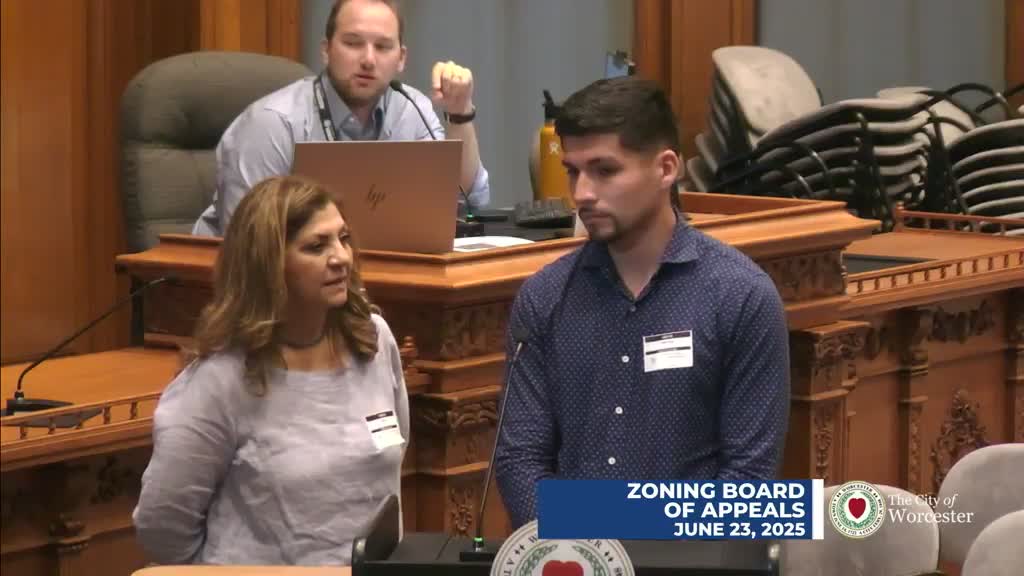
Zoning Board of Appeals members on Monday denied a special permit request from Kenjo Outdoor Advertising to install a non‑accessory, freestanding digital billboard at 5 Norton Drive, a site near Interstate 190 and Indian Lake.
The unanimous vote followed a lengthy public hearing that featured a multi‑hour presentation from the applicant and technical experts, and more than two hours of public testimony from residents, neighborhood groups and elected officials opposed to the sign.
The central dispute at the hearing was whether the sign’s impacts — principally light pollution, visual intrusion and driver distraction on I‑190 — would outweigh the applicant’s assertions that the structure complies with the city’s billboard regulations and modern LED‑display standards. The applicant argued the sign met the ordinance’s dimensional and brightness limits; opponents said the cumulative effect on the lake, wildlife and neighborhood character would be substantial.
Mark Borenstein, an attorney representing the applicant, told the board the company had explored other locations but found 5 Norton Drive in the MG‑1 zoning district met the ordinance’s siting rules. "We are not seeking any variances," Borenstein said, describing the business as a small operator that uses Watchfire LED screens and is prepared to limit the sign’s height to 65 feet from an earlier 75‑foot proposal.
Traffic engineer Victoria Epstein of Stonefield Design said the firm reviewed crash data for 2023–2025 and the roadway geometry and concluded the corridor near the proposed sign is not an unusually complex driving environment. Epstein said the study found collision rates in line with similar interstate segments and that advanced roadway signage and the sign’s placement minimize risk: "It is our professional opinion that this roadway is not a complex corridor and that the sign would not create any kind of adverse impact on this location," she said.
Mike Mallon of Watchfire, the sign manufacturer, described the LED technology, including automatic dimming tied to ambient light and louvers to limit upward light scatter. He said the display would dim gradually and operate at 4% of daytime brightness during nighttime hours and that the system can be controlled to keep light spill below commonly used thresholds.
Neighbors and community groups offered a contrasting view. Carl Gomes, founder of the Indian Lake Community Association, said the neighborhood is actively investing in walkability, green space and public art, and criticized the idea of placing a commercial digital billboard near those efforts. "This sign would not fit into the vision that we have to beautify our city," Gomes said.
Multiple residents and conservation advocates described Indian Lake as a community and ecological resource and warned of impacts to nocturnal wildlife, the lake’s recreational value and home values. Lisa Skavone, who said she lives at Indian Lake and works as a school nurse, told the board that LED lighting affects wildlife and local quality of life: "There’s plenty of data ... it affects wildlife," she said.
City planners and staff told the board the proposed sign met many numerical elements of the ordinance (maximum face area, spacing from other billboards and so on) but recommended additional time to review public comments and Department of Transportation material that had arrived late. The applicant provided additional field measurements during the week of the hearing, including an on‑site lift that was used to demonstrate the proposed sign height in context.
After public comment concluded the board voted on a motion to approve the special permit. The motion failed, with board members Bramhoff, Campanello, Cortez and Barnhagen voting no and the chair also registering a no vote.
The denial leaves the application closed at the Zoning Board of Appeals level. The applicant may choose to pursue other sites, modify the proposal and reapply, or pursue city council or state‑level avenues related to outdoor advertising, but there is no pending ZBA approval from this meeting.
Why it matters: The hearing underscored tensions between state‑permitted highway advertising and locally driven plans to expand green, residential and recreational uses around Indian Lake. Residents argued the sign would have long‑term, visible effects on a neighborhood that city officials and volunteers are actively trying to improve.
What’s next: The applicant said it had offered to continue and provide additional data; after the board vote the application closed. Neighbors and councilors urged changes to notification and overlay rules so similar proposals would either be prohibited or more thoroughly vetted in the future.
Votes and formal action: The board voted to deny the special permit (motion to approve failed).