Get Full Government Meeting Transcripts, Videos, & Alerts Forever!
Get email alerts on the Tree Ordinance topic
No spam. Unsubscribe anytime.
South Pasadena staff propose clearer removal criteria, streamlined permits and capped replacement requirements in tree ordinance update
Summary
City staff presented proposed revisions to South Pasadena’s tree ordinance to replace subjective language, shorten permit timelines, limit mandatory replacement counts, and give the city arborist a primary role in determinations; staff said the draft will go to City Council on July 16.
At a special meeting (date not specified in the transcript), South Pasadena’s Natural Resources and Urban Conservation Commission (NRUC) heard staff present proposed revisions to the city’s tree ordinance intended to replace vague removal language, streamline permitting and revise replacement requirements. Staff said they will present a draft to the City Council on July 16.
The proposed changes aim to replace subjective phrases such as “unreasonable hardship,” “greater value or benefit,” and “substantially interfering” with objective, enforceable removal criteria; to give the city arborist a primary role in determining whether a tree meets removal criteria; and to limit when neighbor-notification letters are required. Danielle Garcia, water conservation analyst, opened the presentation and summarized the goals: “We’re bringing back the tree ordinance update, to review, and get ... final input to the proposed changes that staff has.”
Why it matters: staff said the current ordinance creates inconsistent enforcement and long permit timelines, sometimes up to six months. Commissioners and staff framed the changes as intended to protect the urban canopy while making the process clearer and more practicable for applicants and for staff.
Key proposals and staff clarifications
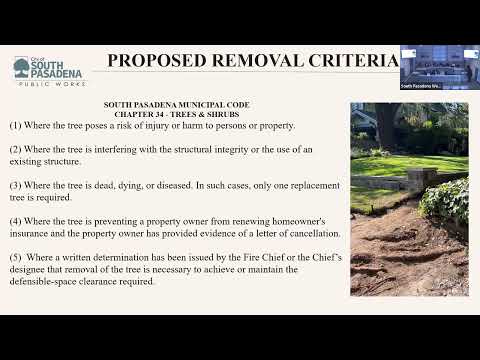
- Objective removal criteria: Staff proposed new, more prescriptive removal categories including (1) risk of harm to persons or property (supported by an arborist report), (2) interference with structural integrity, (3) dead/dying/diseased trees (a category the council recently approved), (4) insurance-related hazards, and (5) defensible space for high fire-severity areas. Garcia said the draft “compels what we’re aiming to include in the updated criteria.”
- City arborist role and appeals: Michael Bartanyans, co–public works director, said the city arborist would be the staff authority to determine whether an application meets the criteria: “our city arborist would be the one to determine if a tree application has met any of these criterias.” If applicants disagree with staff’s decision, staff described a multi-step appeal path: the applicant may obtain a certified arborist report, complete required notification when pursuing an appeal, and bring the matter to NRUC; if NRUC denies, the next appeal is to City Council.
- Permit timing and urgent cases: Staff said typical permitting timelines can take as long as six months depending on the application path; for trees posing imminent risk, staff said they aim to expedite inspections and generally respond within 30 days, though staff noted they would confirm legal liability questions with the city attorney.
- Replacement requirements and caps: Staff proposed capping replacement requirements for routine removals (not associated with development) at three replacement trees and adjusting counts by trunk caliper: 0–16 inches = 1 replacement, 16–32 inches = 2 replacements, greater than 32 inches = 3 replacements. For trees removed as part of development projects the draft scales replacements higher (2, 4 and 6 replacements across the same caliper bands). Staff said replacement trees must be selected from the city’s protected/native tree list; the current minimum 24-inch box size was discussed and staff said they intend to add flexibility tied to site constraints while retaining a meaningful minimum in some cases.
- Fees, enforcement and exemptions: Staff reported that 52 permits have been issued year-to-date and listed current fees as an inspection fee of $141 and a replacement-tree fee of $424 per tree; staff cited a permit fee during the presentation but the transcript’s figure for that line was unclear. Staff also proposed that appeal fees be paid by the appellant and that the city and its contractors be exempt from permitting requirements when acting on behalf of the city for safety or capital-improvement work, to avoid delays on time-sensitive projects.
- Notification and public outreach: The draft limits neighbor-notification letters to denials, appeals, and removals associated with land development, reducing letters for routine approvals that meet objective criteria. Staff said they will publish guidance, checklists and social-media outreach and plan to develop a comprehensive urban forest management plan with an external consultant.
Commissioners’ concerns and staff responses
- Gaming the system and intentional tree damage: Commissioners raised concerns that more-flexible replacement rules could be exploited if property owners intentionally damage trees to trigger removal and a smaller required replacement. Commissioner Cheri Hing urged including provisions addressing intentional damage; staff said they would explore making intentional damage an enforcement violation and emphasized outreach and compliance messaging.
- Conflicting arborist opinions: Commissioners asked how the city would handle conflicting certified arborist reports. Staff said the city arborist’s determination would control for routine permits; if an applicant presents a conflicting certified report when appealing, NRUC would consider that report along with public comments in making a determination.
- Liability and response time: Commissioners asked whether a 30-day response window provides adequate liability protection when a tree poses imminent hazard; staff said they believe 30 days is achievable but will seek city attorney input about legal exposure and confirmed staff will expedite cases that appear to risk immediate harm.
Next steps and timeline
Staff asked NRUC for final input and said the draft will go to City Council for direction on July 16, with a first reading of the draft ordinance later in the summer and a second reading in the fall; staff said they hope the ordinance could be implemented the following winter. No formal motion or vote was required at the NRUC meeting.
Ending
Commissioners praised the scope of the rewrite and emphasized the need to balance closing loopholes with keeping the process clear and timely. Staff said they will incorporate commissioner feedback, produce outreach materials and return with the draft ordinance to City Council on the schedule described by staff.