Get Full Government Meeting Transcripts, Videos, & Alerts Forever!
Get email alerts on the Property Assessment And Tax Policy topic
No spam. Unsubscribe anytime.
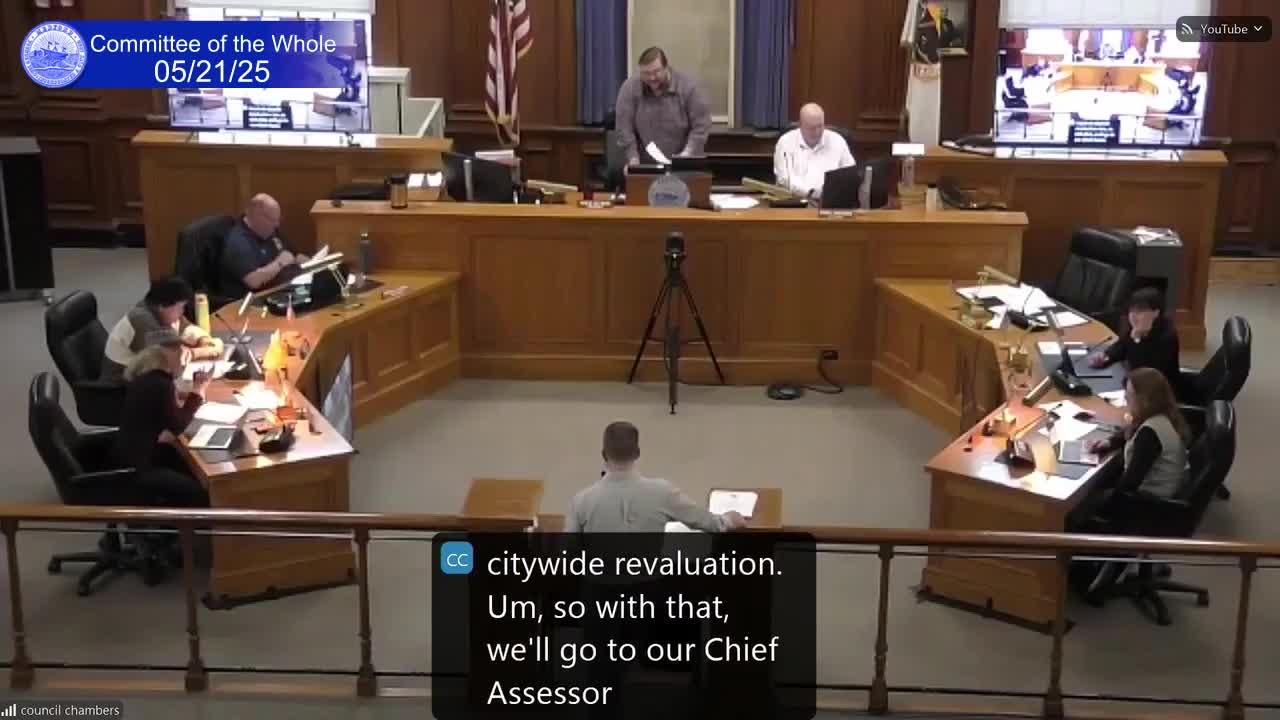
Chief Assessor outlines state-mandated citywide revaluation, warns residential exemption would require added staff
Summary
Chief Assessor described a state-required citywide revaluation (every five years), proposed a $57,000 FY26 expense for certification and mailings, recommended keeping a part‑time field inspector, and told councilors a residential exemption would require substantial additional staffing and a full-time reviewer to process anticipated applications.
Chief Assessor Jared (last name not given in transcript) briefed councilors on the assessing department's FY26 budget and the upcoming state-required citywide revaluation. The department requested a $57,000 new expense for the state revaluation process, which the assessor said is comparable to other communities on a five-year revaluation cycle.
The assessor said staff use Vision software and that the revaluation work is intensive; the state performs a data-quality review on the city's work during revaluation years. He explained the department's goal is to bring all properties to full and fair cash value as of the lien date (January 1) and described the field-inspection and cyclical work needed to maintain accurate data. He recommended keeping a part‑time field inspector in-house for better data quality and said that outsourcing field inspections tends to be more expensive and yields lower data quality.
On a potential residential exemption the assessor said implementation would be labor intensive: to process applications the city would likely need a full-time staffer to review and manage applications and modeling suggested thousands of applications could be expected (the assessor cited modeling that showed about 7,000 would need review under certain assumptions). He and councilors discussed that the exemption reshuffles the levy and that the “breakeven” number of applicants—where benefits accrue vs. costs to the rest of taxpayers—depends on how many households apply and the chosen exemption percentage; the assessor gave an illustrative modeled breakeven around 900 applicants under certain assumptions but emphasized results vary with parameters. He said the department could not implement a residential exemption in the near term without added full‑time capacity and that the budget as prepared would not support processing a new exemption effective the coming fiscal year.
Councilors pressed for context on new growth; the assessor said work in 2023–24 included a large “scrub” of old building permits and that recent new-growth estimates for the next fiscal year range around $2.0–$2.2 million, with larger projects (Herb Chambers, vessel projects on Fells Way, Mystic Valley Parkway site) expected to increase new growth in coming years. He said the state revaluation certification is expected in the coming months and that printing/mailing costs for new values would appear in October notices.