Get Full Government Meeting Transcripts, Videos, & Alerts Forever!
Get email alerts on the Mbta Communities Act topic
No spam. Unsubscribe anytime.
Resident urges Framingham Council not to reduce MBTA Communities district boundaries
Summary
Resident Donna Kilcoyne Othofer told the Framingham City Council she believes trimming the city’s commercial business (CB) district would not jeopardize conditional compliance under the MBTA Communities Act and warned council action taken on erroneous information could impose long-term financial burdens.
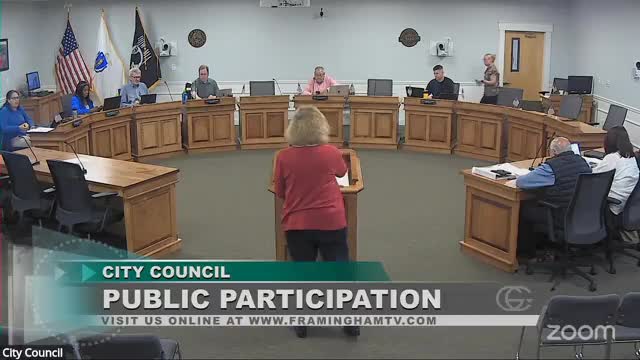
Donna Kilcoyne Othofer, a Framingham resident, told the City Council during public participation that she has followed the MBTA Communities Act process locally and believes reducing the size of the CB (commercial business) district would not endanger the city’s conditional compliance. "I've been following the MBTA Communities Act process in, Framingham," Othofer said, and she said her reading of the statute and recent court rulings leads her to conclude the city could adjust district boundaries without losing conditional status.
Othofer said she reviewed the act and recent amendments and deadlines and believes the city’s economic feasibility study would remain valid if the CB district were reduced while preserving required densities. She said towns that missed the December 31 deadline were given extended time and that "they were given until July 14" to submit adjusted maps.
Why it matters: Conditional compliance under the MBTA Communities Act triggers state review of local zoning to allow more housing near transit; council decisions about the CB district affect where denser housing may be allowed, and residents raised questions about impacts on schools, traffic, public safety and taxes. Othofer said she was concerned the City Solicitor’s letter presented at the June 3 meeting suggested, without definitive language, that adjustments would put the city’s status at risk, and she said the council was being pressured to act on incomplete or erroneous information.
Details from the comment: Othofer cited specific numeric thresholds discussed in the hearing: maintaining 15 units per acre, keeping total capacity above 4,355 housing units and not shrinking the CB district below 50 acres if the council were to adjust boundaries. She also raised the statute’s transit-station distance requirement — generally a half mile — and argued the Act’s definition of "transit station" (which can include bus stations where multiple routes converge) should exclude single-route bus stops; using that narrower reading, she said, would arguably remove areas such as Nobscot and Saxonville from MBTA-compliant zones.
Council response and next steps: Othofer’s remarks were offered during the public comment period and did not trigger a formal council vote. Council members did not adopt any immediate changes to zoning at the meeting; attendees and councilors noted the broader debate about interpretation and timetable will continue as the city finalizes maps and supporting studies.
Othofer closed by saying she worries about future fiscal impacts if the council moves without clarity: "We will need to take approximately 10,000,000 out of free cash. I think we're leaving ourselves in a real bind for futures. Future generations should not be burdened by bad decisions now."