
Framingham Fire Department outlines rising call volume, staffing and facility needs
Get AI-powered insights, summaries, and transcripts
Subscribe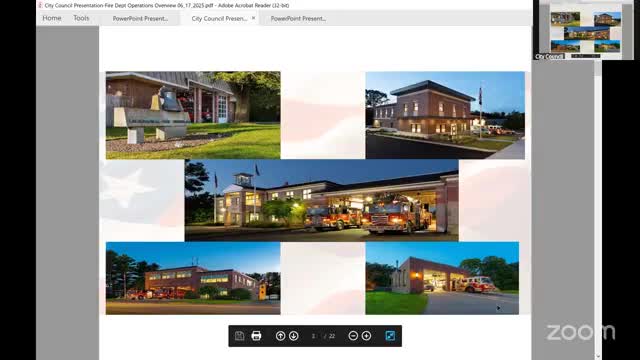
Summary
Fire chiefs told the council call volume has roughly doubled since 1998, with increasingly complex medical and technical responses; chiefs urged consideration of station, staffing and facility investments and flagged response‑time pressures on the west side.
Framingham’s fire leaders told the City Council on June 17 that call volume and complexity have risen sharply and that aging stations and thin staffing create operational strain as the city grows.
Key facts and figures: Acting Chief/Deputy chiefs reported the department has about 154 full‑time employees, 149 of them uniformed. The department operates five fire stations with five engines, a 100‑foot aerial tower, a heavy rescue, four boats, two brush trucks and additional technical‑rescue assets. The department said it responded to roughly 14,000 calls in the most recent year versus about 7,500 calls in 1998, an increase the chiefs described as about 61% since 1998 and roughly 20% over the last five years.
Medical responses and staffing: Fire leaders said emergency medical services account for roughly 60–65% of responses; last year the department reported about 9,000 EMS requests and about 7,500 transports, with roughly 85% of transports to MetroWest Medical Center. Chiefs said higher call volumes, more complex patient needs and denser multi‑story buildings increase the demand for trained staff and equipment.
Facilities and response times: Chiefs warned some stations date to the 1960s and that facilities and equipment are under constant strain. They highlighted response‑time pressures on the west side (Engine 7 coverage area), saying longer travel times to support downtown high‑rise responses can leave neighborhood coverage thin. Chiefs raised revisiting a west‑side station and pursuing ISO rating improvements as options to lower response times.
Training and special teams: The department underscored district‑level mutual aid for dive and technical rescue teams (around 22 communities, roughly 40–45 members per team), shared mass‑decontamination and other regional resources, and said the department maintains training and joint teams that respond beyond Framingham.
Council reaction and next steps: Councilors praised the department and asked departments and the mayor’s office to continue exploring long‑term staffing, station and funding options. No formal action or budget appropriation was taken during the meeting; councilors requested follow‑up information on response‑time studies and staffing scenarios.