Get Full Government Meeting Transcripts, Videos, & Alerts Forever!
Get email alerts on the Childcare Tax Credit topic
No spam. Unsubscribe anytime.
Montgomery Council hears support for expanding child‑care property tax credit to reach more providers
Summary
Delegate Julie Polakovich Carr and county advocates urged the Montgomery County Council to adopt Bill 21‑25 to expand and increase the county’s daycare and child‑care property tax credit, saying the change would help struggling providers and improve access.
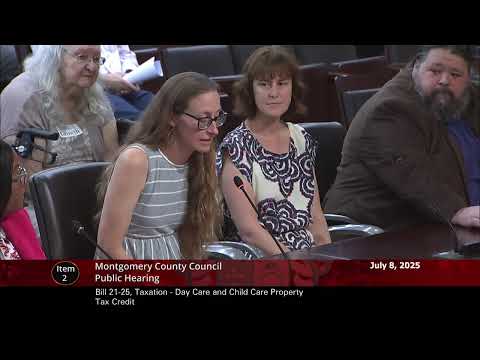
Delegate Julie Polakovich Carr, a Maryland state lawmaker who sponsored the enabling legislation at the state level, told the Montgomery County Council on July 8 she strongly supports Bill 21‑25 to expand the county’s daycare and child‑care property tax credit.
“This is a real issue,” Delegate Polakovich Carr said. “It actually costs more to have your child in daycare than it is to send them to college.” She described workforce and business losses and urged careful outreach and program design so the credit reaches providers who need it.
Why it matters: supporters said the proposed county changes would both raise the dollar cap on the credit and broaden eligibility to provider types that are currently excluded, aiming to ease operating costs for small providers and promote greater access to child care countywide.
County and nonprofit advocates framed the change as part of a multi‑front effort to address a child‑care crisis. David Rowley, chair of the Montgomery County Community Action Board, said the county’s kindergarten readiness rate is 44 percent and that disparities are linked to race, income and limited early‑childhood access. Kimberley Rusnak, executive director of the Montgomery County Children’s Opportunity Alliance, said the bill would make large family child‑care homes eligible and noted there are about 63 large family child‑care homes in the county based on May 2025 licensing data.
The bill would increase the tax credit amount cited in earlier county code from $3,000 to $10,000 and would expand eligibility to additional provider types and to businesses that provide on‑site child care for employees, supporters said. Christopher Connell of SEIU Local 500 urged the council to “swiftly pass this bill,” saying property tax relief would cut a major cost for providers and help stabilize a workforce still recovering from pandemic‑era losses.
Speakers repeatedly pressed the council to design implementation so the credit is easy to apply for, reaches rented facility operators as well as owners, and allows municipalities that wish to adopt complementary credits to coordinate with the county so providers can apply once for multiple benefits.
What the council will do next: the public hearing closed after testimony and the council noted a Government Operations and Fiscal Policy Committee work session is scheduled for July 17, 2025; the deadline for submitting material was listed as close of business July 10, 2025.
No formal vote on Bill 21‑25 occurred at the hearing; the item remained in the public‑comment stage going into committee review.