Get Full Government Meeting Transcripts, Videos, & Alerts Forever!
Get email alerts on the Council Accomplishments topic
No spam. Unsubscribe anytime.
Cleveland council president outlines three-and-a-half-year record of housing, worker protections and safety investments
Summary
The Cleveland City Council president delivered a public briefing summarizing the council’s policy achievements and outlining ongoing priorities, including housing investments, lead remediation fundraising, worker protections, public-safety initiatives and planned oversight of program implementation.
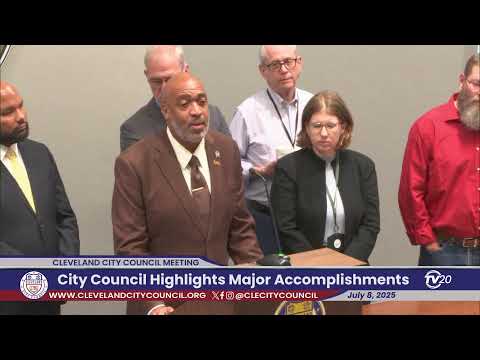
Council President, speaking at a public briefing, summarized the Cleveland City Council’s accomplishments over the past three-and-a-half years and outlined priorities the body will monitor going into the final semester of its four‑year term.
The council president said the council has focused on housing and neighborhood development, worker protections and economic opportunity, public safety and justice, health and social services, and arts and culture. He listed specific programs, funding amounts and policy changes the council has supported and said council will use oversight processes to evaluate implementation.
The nut of the briefing was that council members pushed legislation and funding aimed at affordable housing and tenant protections. The president cited a $30,000,000 housing gap financing allocation, $59,000,000 in ARPA housing investments for seniors, veterans and other units, and a Cleveland Housing Investment Fund supporting neighborhood projects. He said council used ARPA funds to allocate about $20,000,000 for broadband and digital access and that the council helped raise roughly $115,000,000 to address lead hazards in partnership with the Cleveland Clinic and other organizations. “We allocated dollars. We create policy. We do oversight,” the council president said.
On worker protections, the president credited the council with passing pay-transparency requirements for job postings, prohibiting employers from asking salary history, updating the city’s fair-employment law, increasing the living wage and adopting measures addressing wage theft and payroll fraud. He named paid parental leave and paid safe leave among adopted policies, and he said a community‑benefits ordinance now guides projects that receive public funding to prioritize local minority‑ and women‑owned businesses, jobs and community input.
Public safety measures the president highlighted include a neighborhood safety fund to support prevention and intervention services housed at the Cleveland Foundation, investments in cameras and dashcams, updates to the nuisance-property ordinance and a focus on prevention strategies such as street outreach workers and violence interrupters. He said the council has sought to balance prevention programs with the need for a well‑equipped police department.
The president discussed several neighborhood and economic development efforts: $10,200,000 in the 2024 budget for neighborhood investments, a $20,000,000 allocation for the Westside Market, the Woodhill neighborhood transformation project he said will bring about $400,000,000 in investment, and targeted investments in the JFK area. He also cited a new community authority and coordination with the North Coast Waterfront Development Corporation to secure what he described as $150,000,000 for lakefront projects.
The president said the council will continue oversight of recently passed laws and programs — including the Lead Safe implementation and a “Residents First” law to hold some out‑of‑state landlords accountable — and that some implementations have shown “hiccups” that require review. He told reporters council members would meet with the Lead Safe steering committee and other implementers to assess effectiveness and possible adjustments.
The president identified utilities infrastructure as an area for further work and said he had asked Councilman Casey to examine the city’s electrical infrastructure and potential investments after recent rolling blackouts. He also raised redistricting as a difficult recent process and defended the council’s approach as designed to achieve more even voter‑distribution across wards.
The briefing included multiple attributions of work to council colleagues and external partners; the president repeatedly framed the council’s role as legislating, allocating funds and conducting oversight rather than directly managing service delivery. He characterized several items as accomplishments to be monitored rather than completed policy victories.
Ending the briefing, the council president thanked council colleagues and the media and said the body will continue to evaluate programs and investments going forward.