Get Full Government Meeting Transcripts, Videos, & Alerts Forever!
Get email alerts on the Local Budgeting topic
No spam. Unsubscribe anytime.
Waunakee budget committee presents 2025–26 draft tied to state funding gains but flags property tax pressure
Summary
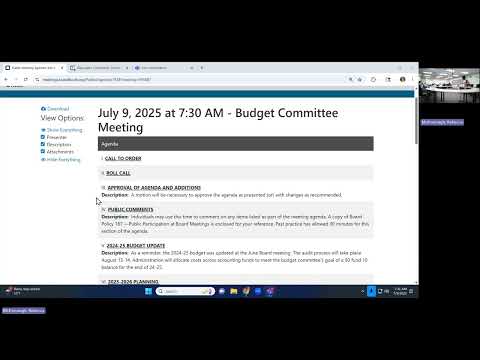
Waunakee Community School District staff told the district budget committee on Jan. 9 that recent state budget agreements boost spendable revenue for 2025–26 but that equalization changes will increase local property tax pressure.
Waunakee Community School District staff told the district budget committee on Jan. 9 they will present a 2025–26 budget to the full school board that reflects recent state budget agreements — including higher special education reimbursements and increased open‑enrollment funding — while flagging a likely increase in the district’s property tax levy.
“We’re going to be able to present to the public the accurate version of our budget based on the final state budget,” said Steve Summers, staff member, who led the committee presentation. Summers told the committee the district has placed most new spendable resources into long‑term financial priorities identified in prior board workshops.
The committee was asked to review and forward a third draft of the 2025–26 budget to the full board for approval as the district’s “annual meeting” version. The committee moved and approved sending that draft to the board, with the board scheduled to consider a final budget and tax levy in October after the district confirms its September student count and the state posts final equalized property values.
Why it matters: The state budget changes create a mix of new revenue and local tax pressure. Summers described the changes as “two sides of a coin.” On the upside, the state increased reimbursements for special education high‑cost aid and boosted open‑enrollment payments — both areas in which Waunakee reports strong claims and net gains. On the downside, the revenue limit increase of $325 per pupil is not tied to new equalization aid statewide; instead the state redistributed existing equalization dollars. That redistribution reduced Waunakee’s equalization aid in July by about $1 million under the state formula, Summers said, driving local levy pressure.
Major budget placements and assumptions
- Fund 10 target: District staff reiterated a prior committee goal that general fund (Fund 10) would end fiscal 2024–25 at approximately a $0 balance after audit adjustments.
- New placements: Staff put $600,000 into the Fund 73 post‑employment benefit trust payment, doubled contingency from $100,000 to $200,000, added $100,000 for termination (separation) benefits, and added $100,000 to legal services. Summers said these allocations are open to board review this fall.
- Transportation: The third draft includes $100,000 to expand district transportation capacity (see separate item on transportation and McKinney‑Vento students).
- Tax levy impact: The package shown to the committee produces a 10.4% increase in the overall levy for 2025–26 when operational, referendum and debt service levies are combined, according to staff projections shown to the committee. Summers and Ali Newton, staff member, said the district plans a full discussion of options to reduce that levy at the board’s August workshop.
State budget details discussed
Summers summarized the state budget items that most affect Waunakee:
- Special education high‑cost aid: Summers said the district received a 30.6% reimbursement level in 2024–25 (below an intended 33%) and that state documents advertise higher percentages for coming years (advertised 42% for 2025–26 and 45% for the next biennium). Summers cautioned the advertised percentages differ from assumptions used by the Legislature’s joint finance committee and that the actual reimbursement may be a few percentage points lower than advertised. Staff also described later‑year advertised reimbursement increases (staff used phrasing that the state will raise reimbursement to 50% and then to a much higher figure in a following year); staff positioned the district to maximize high‑cost aid claims because Waunakee is a consistent high claimant in the state.
- Open enrollment: The district reported a substantial net gain in open‑enrollment students — roughly a 200–250 student net gain — and staff said increased open‑enrollment transfers in the state budget will boost revenue for Waunakee.
- Revenue limit and equalization aid: The $325 per‑student revenue limit increase remains in the law and, according to staff, is effectively paid by local property taxpayers when equalization aid is not increased. Summers said this produced the July estimate showing about a $1 million drop in Waunakee’s equalization aid under the revenue limit math.
Committee action and next steps
The budget committee voted to forward the state‑budget version of the 2025–26 budget to the full board with the understanding the board will: (1) adopt an “annual meeting” version at its next meeting for public notice; (2) hold an August workshop to consider levy‑reduction strategies and long‑range impacts on proposed capital projects including a high‑school plan; and (3) make final decisions on the levy and budget in October after enrollment and equalized values are final.
“There is incredibly positive news on the spendable revenue end. There’s concerning news for those who are property taxpayers,” Summers said.
Ending
Staff and the committee pointed to multiple change points between July and October (student counts, equalized property values and open‑enrollment totals) and emphasized the board retains authority to change contingency, legal funding, or other line items as it moves toward final adoption later in the year.